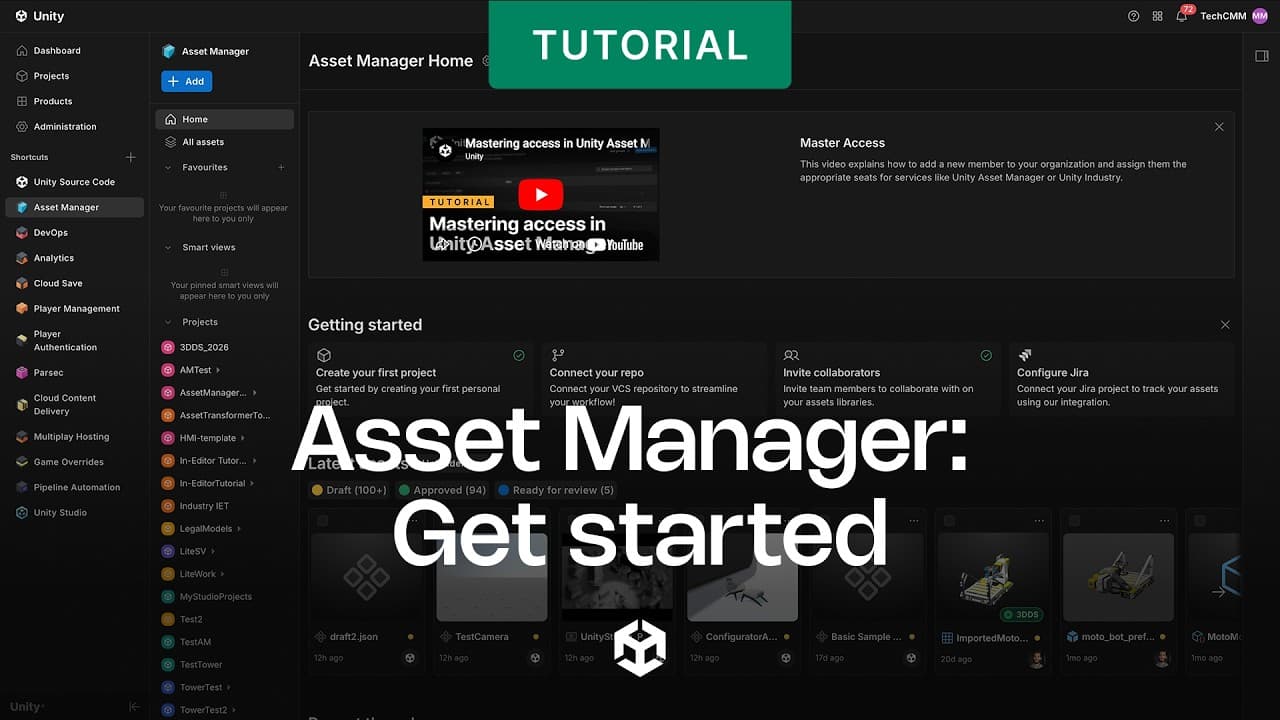
FAQ: Set up 3D data workflows for teams in Unity Asset Manager

Unity Asset Manager is a centralized platform available via Unity Industry Cloud that enables teams to manage 3D assets. It supports structured metadata, version history, asset control, and file streaming. This ensures that asset state and traceability stay consistent through review, optimization, and downstream workflows.
This FAQ is based on the video tutorial Unity Industry Cloud: Unity Asset Manager. It covers how to access Unity Asset Manager, set up a project, and upload CAD files; organize assets, tag them with custom metadata, inspect and view them, and optimize and convert them to production-ready assets.
This guide is for hands-on users and admins who manage CAD and 3D assets, plus technical leads on industrial teams.
Key takeaways
- Centralize CAD and 3D asset management with Unity Asset Manager; learn about how to set up a project and upload CAD files.
- Organize assets into collections and describe them with tags and custom metadata.
- Use 3D streaming to inspect geometry, materials, and subcomponents in the hierarchy before downstream use.
- Optimize and convert to produce production-ready outputs such as FBX files for the Unity Editor or GLB for Unity Studio.
- Set asset status so assets become easier for teams to discover, review, download, and reuse across projects.
This guide is for hands-on users and admins who manage CAD and 3D assets, plus technical leads on industrial teams.
What is Unity Asset Manager?
Unity Asset Manager is a centralized system for managing CAD and 3D assets across teams in Unity Industry Cloud. It keeps asset state consistent and traceable from review through optimization and downstream use. For strategic context, see Establishing one source of truth for 3D asset data.
Key capabilities of Unity Asset Manager include:
- Structured metadata describes and classifies each asset.
- Version history tracks changes to a source file over time.
- Asset controls help the right people manage and use assets.
- File streaming supports live preview and downstream workflows, such as review, optimization, use in Unity Studio, or use in the Unity Editor.
Unity Asset Manager sits within the broader Unity Industry Cloud asset journey, which spans uploading and organizing CAD files, collaboration and review, use in Unity Studio or the Unity Editor, and pipeline automation.
Timestamps:
(0:02): Unity Industry Cloud overview
(0:34): What is Unity Asset Manager
Unity documentation:
How do I access Unity Asset Manager and what permissions do I need?
Unity Asset Manager is available from the Unity Dashboard. You need the Owner user type to create a project.
To set up access, follow these steps:
1. Log in to the Unity Dashboard.
2. Click the + button next to Shortcuts, then select Unity Asset Manager to add quick access.
3. Confirm you have the Owner user type to create a project. If you don't have the Owner user type, ask an organization administrator to assign it from the Members section in Administration. For more detail, see roles, seats, and project permissions in Unity Asset Manager.
Timestamps:
(0:52): Add Unity Asset Manager to shortcuts
(1:00): Owner user type and admin grants
Unity documentation:
How do I upload and organize CAD files in Unity Asset Manager?
You organize assets inside projects and collections, then upload files into them. Collections group related assets so they are easier to find.
To upload and organize files, follow these steps:
1. In the Unity Asset Manager view, create a project by clicking on New project.
2. In the Collections view, click Add, select Collection, and name it to group related assets.
3. Click on the Add button to upload files or drag them into the collection.
Unity Asset Manager supports common file formats for CAD and 3D assets. The full list of supported formats is available in the Unity documentation.
See how to install and use Unity Asset Manager.
Timestamps:
(1:11): The three main steps
(1:34): Create a project
(1:43): Add a collection and upload files
(1:51): Supported file formats
Unity documentation:
How do I add metadata and tags to my assets in Unity Asset Manager?
Click an asset to open its details panel, then describe it so team members understand what it represents and how to use it. Good metadata makes assets discoverable later.
You can set the following on each asset:
- Name and description that explain what the asset represents
- Asset type, set automatically from the file extension but adjustable from the drop-down menu, for example, to a 3D model or a texture
- Tags that describe usage, product line, or platform
- A custom metadata field, such as text, number, Boolean, or a list of predetermined values
The initial status is Draft, indicating the first step in the asset's lifecycle. Clear metadata helps teammates find the right asset later without opening every file or asking the original uploader.
Timestamps:
(2:01): Open the details panel
(2:10): Adjust asset type
(2:22): Add tags and a custom field
(2:40): Field types and draft status
Unity documentation:
How do I inspect a CAD model's geometry and hierarchy in Unity Asset Manager?
Enable 3D Data Streaming to preview the model and explore its structure in the 3D viewer. This optional step lets Unity Asset Manager stream the model and shows the hierarchy in the 3D preview.
To prepare and inspect a model, follow these steps:
1. Click Edit files for the asset.
2. Select Prepare for 3D Data Streaming on the source file, then click Save new version.
3. Open the 3D viewer to access the complete hierarchy, including parts, assemblies, and subcomponents.
4. Rotate, zoom, and pan to inspect the model, and select elements to examine their properties.
You can also adjust environment settings or isolate elements to review specific details. A clear hierarchy and clear names make the asset easier to understand. Inspecting the model before downstream use helps you catch geometry or hierarchy issues early. For a deeper look, watch Validate, navigate, and annotate complex 3D files with Unity Asset Manager.
Timestamps:
(2:55): Prepare for 3D Data Streaming
(3:04): Inspect the complete hierarchy
(3:17): Rotate, zoom, pan, and isolate
Unity documentation:
How do I optimize and convert CAD files for production in Unity Asset Manager?
After you are satisfied with the structure and quality, you can optimize and convert the source file into a production-ready format. You choose which optimizations to apply and a target format that fits the destination.
To run Optimize and Convert, follow these steps:
1. Click Edit files and select the source asset.
2. Choose Optimize and Convert.
3. Enable only the optimizations you want, such as mesh cleaning or polygon reduction.
4. Select a target format that fits your destination, for example FBX for the Unity Editor or GLB for Unity Studio.
5. Click Run optimization to start the job. Learn more about how to optimize complex models with Asset Transformer Toolkit and getting started with Asset Transformer for Unity for Industry.
Timestamps:
(3:32): Optimize and convert the source file
(3:42): Optimizations, target format, and run
Unity documentation:
How do I publish assets and make them discoverable in Unity Asset Manager?
After optimization completes, finalize the asset so team members can find and reuse it. You set a status that reflects where the asset sits in your workflow.
To publish and share an asset, follow these steps:
1. Add any final metadata and tags, for example, the optimization settings that were applied.
2. Move the asset to a collection for finished or shared assets if that fits your workflow.
3. Set the status from the drop-down menu, such as draft, in review, or published.
4. Team members can search by name, tag, or metadata to discover the asset.
Team members can view the history of all versions and download the optimized outputs for use in their projects. Setting a clear status keeps everyone aligned on which assets are ready to use. Learn more about collaborative development with Asset Manager and version control and common 3D asset management challenges.
Timestamps:
(3:59): Add final metadata and tags
(4:09): Move to a collection and set status
(4:23): Search, version history, and downloads
Unity documentation: