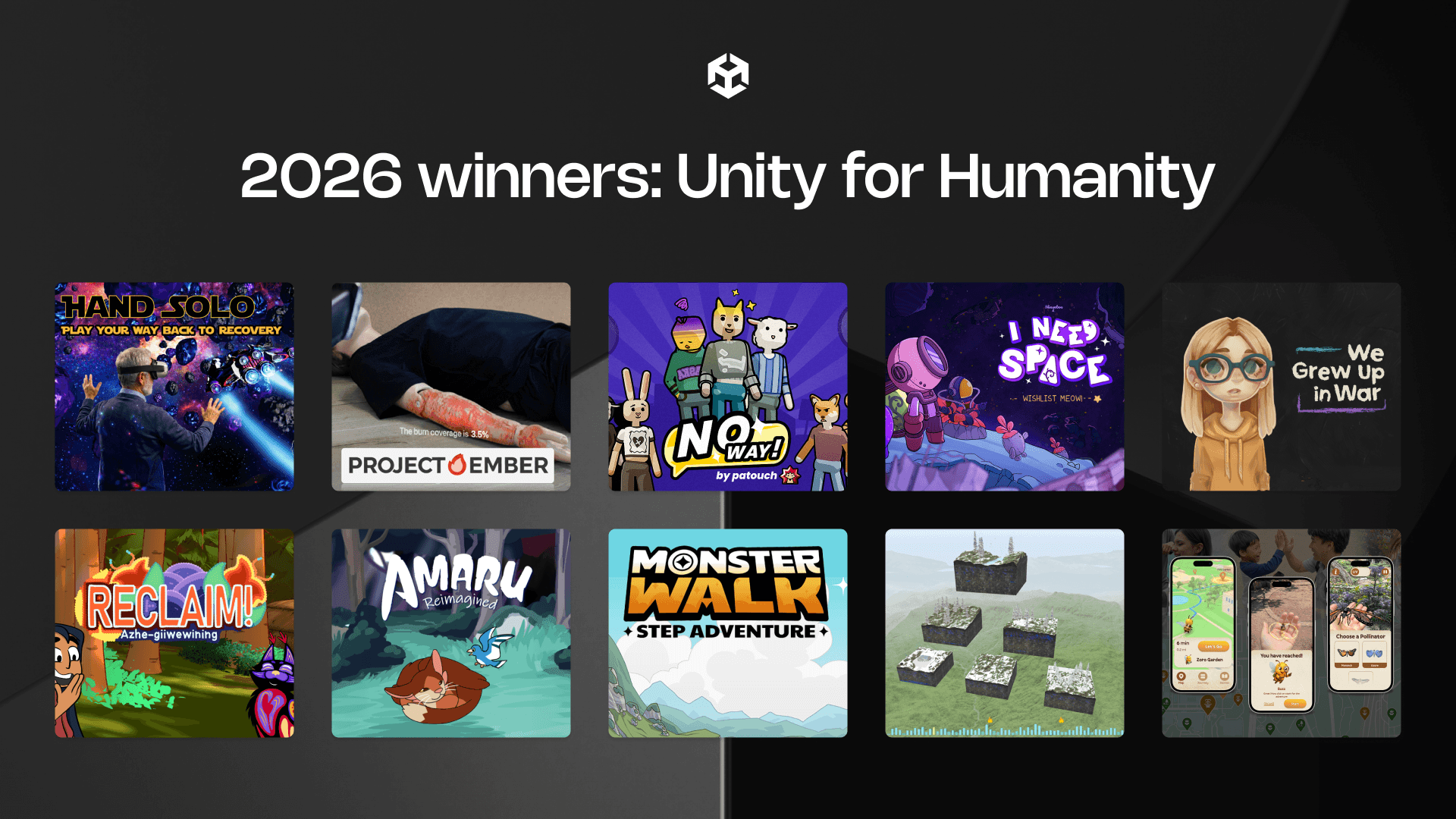
We are thrilled to introduce the 2026 Unity for Humanity Grant winners! This year, we recognize 10 winners and 3 honorable mentions, with recipients spanning eight different countries. The projects address complex global challenges aligned with the UN Sustainable Development Goals.
With more than 515 applications received, this marks a second consecutive year of record submissions, reflecting the growing global momentum behind using real-time 3D to drive positive change.
We are proud and honored to allocate a prize pool of $600,000 USD from the Unity Charitable Fund to support a roster of projects which bring impactful, valuable, and viable contributions and demonstrate innovative technological and content solutions to address important problems. Funding can be allocated towards the development of the project, building a working prototype, or marketing and distribution.
Creators are changemakers and Unity is the platform for bringing their vision for a better world to life. We hope that our funding accelerates their progress and helps drive lasting real world impact.
Join us to celebrate the winners!
Congratulations to all of this year’s winners and honorees! We are excited to follow their journeys and share more about their groundbreaking projects. Join our upcoming Unity for Humanity livestream on YouTube (or simulcast to Twitch) on Thursday, May 21st from 12-1pm Eastern Standard Time to hear directly from the winners and learn more about their work. Click through to the Youtube event and select 'notify me' to get a reminder.
Meet the 2026 Grant Winners (Listed alphabetically by project title)

Amaru Reimagined (Six Wing Studios, Inc) - An expanded remake of the beloved title Amaru: The Self-care Virtual Pet. Amaru Reimagined builds beyond Amaru’s “self-care app meets pet game foundation” with endless multiplayer play, seasonal events, localization, and more. Amaru supports players in forming self-care habits like mindfulness meditation and gratitude journaling that help build resilience to these conditions.
What we liked about this project: Amaru has a proven track record, with 1MM downloads and university study showed that playing Amaru reduces anxiety and depression in players at clinically meaningful levels. We like how the studio is taking all the learnings from the existing iteration and applying them to the remake, for the purpose of making it financially sustainable, continuing to serve its large community of users, and expanding its beneficial reach even further.
Country: USA

Balboa Park Alive! (Arizona State University): Balboa Park Alive! immerses families in a journey through one of America's most biodiverse regions, where children plant native gardens, release endangered butterflies from their hands, and see firsthand how climate change reshapes local ecosystems. A mobile AR app and companion storybooks with AR-activated content extend the experience from park to home, supporting caregiver-mediated informal learning through play.
What we liked about this project: The app is free, mobile-first, and built for informal settings: parks, backyards, living rooms. It also widens access to environmental literacy for families often left out, those without proximity to museums or structured programming.
Country: USA

Future Mountain (Bren School of Environmental Science, University of California, Santa Barbara) - An interactive gamified visualization tool that translates complex Earth System Model data into an explorable landscape, allowing non-experts to view how water in streams and groundwater, fire regimes, and vegetation in their local environment interact and respond to climate at different time and spatial scales. By turning visible and invisible environmental processes into playable spatial narratives, the project builds climate literacy, fire risk awareness, and promotes public engagement with the scientific research that supports climate adaptation and risk management choices.
What we liked about this project: We liked how it originated from the scientific field and has the goal of turning complex data into accessible knowledge. It aims to improve climate literacy for non-experts, support systems-level understanding of how climate, vegetation, fire and water co-evolve, enabling informed community dialogue around wildfire, floods and droughts.
Country: USA

HandSolo: Play your way back (University of San Martín) - a VR rehabilitation game that helps chronic stroke survivors regain lost hand dexterity using motor training backed by scientific research. Affordable and designed for use at home, it makes high-quality therapy accessible beyond specialized clinics, democratizing access to recovery.
What we liked about this project: Stroke is a leading cause of long-term disability, with impaired finger dexterity among its most limiting consequences, and this game’s core innovation is the delivery of biologically timed rehabilitation at home. The Unity for Humanity grant funding will enable them to transition to a clinically deployable product within the public healthcare system.
Country: Argentina

I NEED SPACE (Khalayan Arts) - The game is artfully designed to be a reflection of unattractive environmental issues such as climate change, coastal fracking, deforestation, waste management challenges - all woven into the fabric of a cautionary tale, with the ultimate aspiration of encouraging a significant portion of our audience into adopting eco-friendly lifestyles and participating in environmental initiatives.
What we liked about this project: The studio has an established track record of impact-oriented game development (we supported another project of theirs, Samudra, in 2020) and lives what it preaches through multiple other initiatives it organizes or participates in. We are thrilled to see their evolution into a beacon of sustainability initiatives in Indonesia with their gorgeous looking new project.
Country: Indonesia

NoWay! (Patouch Association) - This educational video game helps young people understand violence, recognize their role in a conflict situation, and respond appropriately. Through immersive and interactive scenes, it combines prevention, learning, and reflection, while inspiring players to pursue further training.
What we liked about this project: The studio’s decades-long practical experience with highly engaging work in violence prevention, that is underlying the game - including playful educational tools, tailored workshops, a confidential helpline, a print magazine, and more. The game aims to bring the benefits of their successful approach to an international audience, thus expanding its impact.
Country: Switzerland

Project Ember (Buckinghamshire Health Research & Innovation Centre) - a Mixed Reality platform that democratizes "gold standard" burn management training by replacing £120,000 physical mannequins with free, scalable digital simulations. It is the first medical training tool to feature a dynamic skin-tone engine, eliminating diagnostic bias and ensuring equitable life-saving care for the global majority.
What we liked about this project: The smart application of real-time 3D technology to solve a problem in a way that is both better and cheaper. Instead of relying on expensive props providing a limited training scenario, the mixed reality dynamic system allows the creation of unlimited training scenarios for realistic digital burns that vary by skin tone, age, depth, type, location, etc., directly addressing a major global health and training gap.
Country: United Kingdom

Monster Walk (Talofa Corporation) - a “walk-to-play” game which turns your daily steps into fuel for your journey through a world on the rise from ruin. The creators are cultivating a community that integrates gaming, wellness, and social connection to foster healthier lifestyles. This dual-world approach - where physical activities translate into virtual progress - encourages consistent engagement, making exercise feel more rewarding and less daunting.
What we liked about the project: Gamifying the healthy behavior of spending time outside and getting your steps in - and in a way that was has proven success: they exceeded 1 billion steps taken by players in the first 2 weeks of launch. The Unity for Humanity grant funds will be used to refine the platform and expand the content with mini games and new fitness types.
Country: USA

Reclaim! Azhe-giiwewining (returning home) (Grassroots Indigenous Multimedia) - As Miskwaa, forge a path through a forest teaming with spirits, stories, and intricate puzzles inspired by Ojibwe (Native American) culture and language in this all-new point and click adventure. It invites you to immerse yourself in a world where language is the key to coming home, and the game is playable in the indigenous language, Ojibwemowin or Anishaanbemowin, one of the three largest indigenous language groups in North America.
What we liked about the project: This game is aimed at preserving an indigenous language threatened by extinction. Only by speaking the language with the NPCs in the game, and listening to their responses and pointers, will the player be able to solve the puzzles. The studio has also developed a free language learning tool, and has repurposed scripts and assets from the game into the lessons in the tool. Unity for Humanity grant funds will help build a mobile version of the existing PC game.
Country: USA

We Grew Up in War (Charles Games s.r.o.) - We Grew Up in War is a powerful testimony based on real stories of children who lived through wars in Ukraine and Bosnia. Experience their world shaped by fear and imagination and witness their memories in all their raw, haunting truth.
What we liked about this project: This game takes the perspective of children, and takes a different focus - one of resistance and resilience and hope.The well established track record of the studio with games aimed at social and historical educational impact, driven by a founder who holds a PhD for his work on the transformative power of video games.
Country: Czech Republic
Honorable Mentions

LSI Adaptive Sports League (Limbitless Solutions University of Central Florida): They are developing the first adaptive digital sports platform powered by facial muscle flex, enabling individuals with progressive neuromuscular conditions to compete, train for real-world wheelchair independence, and reclaim their role as athletes regardless of physical decline.
What we liked about this project: Their student development team includes designers with personal experience developing for mobility devices in clinical settings. This lived experience ensures they address nuanced accessibility that outside designers often miss, moving beyond optics to functional, insider-led innovation.
Country: USA

Storiweave (Organized Khaos): StoriWeave is an innovative "physical-digital" learning platform. Their debut story, Kuukua's Science Adventures: Harnessing the power of the Sun, is an interactive story, where kids can play the story and make different decisions to learn, a physical deck of cards, children (ages 6-13) can arrange to build a solar-powered fan in AR, which when scanned with their free Unity-powered AR app, the cards trigger interactive 3D animations, turning any tabletop into a functioning solar farm, and finally physical science kits that kids can put together to make their own fans all from one story.
What we liked about this project: the StoriWeave app is completely free, meaning kids who cannot afford the AR cards can still enjoy the free interactive stories on the platform and can learn with or without the AR experience, and Organized Khaos is a Ghanaian-led studio building specifically for African children.
Country: Ghana

Unimora - Building Empathy and Attraction for the Future of Care (Mindflight 7): Unimora is a high-agency VR platform that allows students to inhabit the sensory reality of aging before mastering the life-changing skills of a professional career. By transforming clinical tasks into human-centered Unity-based interactions, they inspire Gen Z to solve the global care crisis with confidence and compassion.
What we liked about this project: The global aged care sector faces a critical worker shortage because young people cannot "see" themselves in the role. Unimora changes this by providing an immersive and rewarding career experience.
Country: Australia
If you are interested in the Unity for Humanity Program, please join our Discord channel and sign up to receive updates, or view our website.