Bridging worlds: Immersive commerce with Walmart & Pigiama Kasama

Use case
Immersive commerce, commerce in games
Industry
Retail
Tech
Unity Industry
Impact
Customer engagement
Rob Oates, Senior Director, Tech Strategy and Emerging Tech at Walmart and Paride Stella, Co-founder at Pigiama Kasama, discuss the groundbreaking series of mini-games reshaping immersive commerce - ‘Walmart Unlimited’. Discover the inspiration behind the project, and why Unity's retail solutions were their chosen creative tech.
Transcript
My name is Rob Oates and my role I am a senior director in the tech strategy and emerging tech group at Walmart and I run the immersive commerce program. What my team does is we build what is essentially a business-to-business technology that allows game developers to integrate into their titles and once they've done that they can then sell real-world products from Walmart in their games to their players.
My name is Paride Stella, I'm the co-founder of Pigiama Kasama. Pigiama Kasama is a game production studio, but it has a bunch of different interests in many fields. We do games for entertainment of course but also for marketing purposes, just like the Walmart Unlimited project. But also we cover and serve the industry by making applications for the manufacturing industry or other fields that might require real-time applications.
The visionaries
RO: My background is, I was a game developer for a number of years before I moved on to the business side. I was a 3D game engine programmer and gameplay programmer and AI specialist. I remember when we were working on one of the engines, some folks, I think they were senior engineers at the time, they were like, there's this group out of Copenhagen and they're actually using C-sharp to make a game engine so you don't have to write in C++. And I was like, “that'll never catch on”.
And then come a few years later. I had played around with it a little bit, I loved C sharp much more than I loved programming in C or C++ or Assembly, and I was in a position at a studio that got acquired where I got to make a selection of what technology we were going to use, and I pushed for Unity at the time.
PS: My background is a little bit different, I was more in the design field. But when we founded Pigiama Kasama, pretty much all the team was using Unity, they introduced me to Unity and I learned about it. And actually Unity has been the core foundation of our technical stack since day one.
The commerce gap
RO: Why does Walmart care about this space? Aside from my personal interest having come from this industry and being a diehard gamer, it's about being where the customers are and where they're spending their time. There's a huge opportunity here to serve players with stuff that they want to buy. People spend 150 times as much on physical goods as they do on virtual. And so how do we help developers participate in the $30 trillion physical commerce business that exists globally, as opposed to being stuck in just the $200 billion games revenue business? That's the problem that I've been trying to solve kind of my whole career - to figure out how to expand developer revenue. So I think we've got a huge opportunity here.
Building Walmart Unlimited
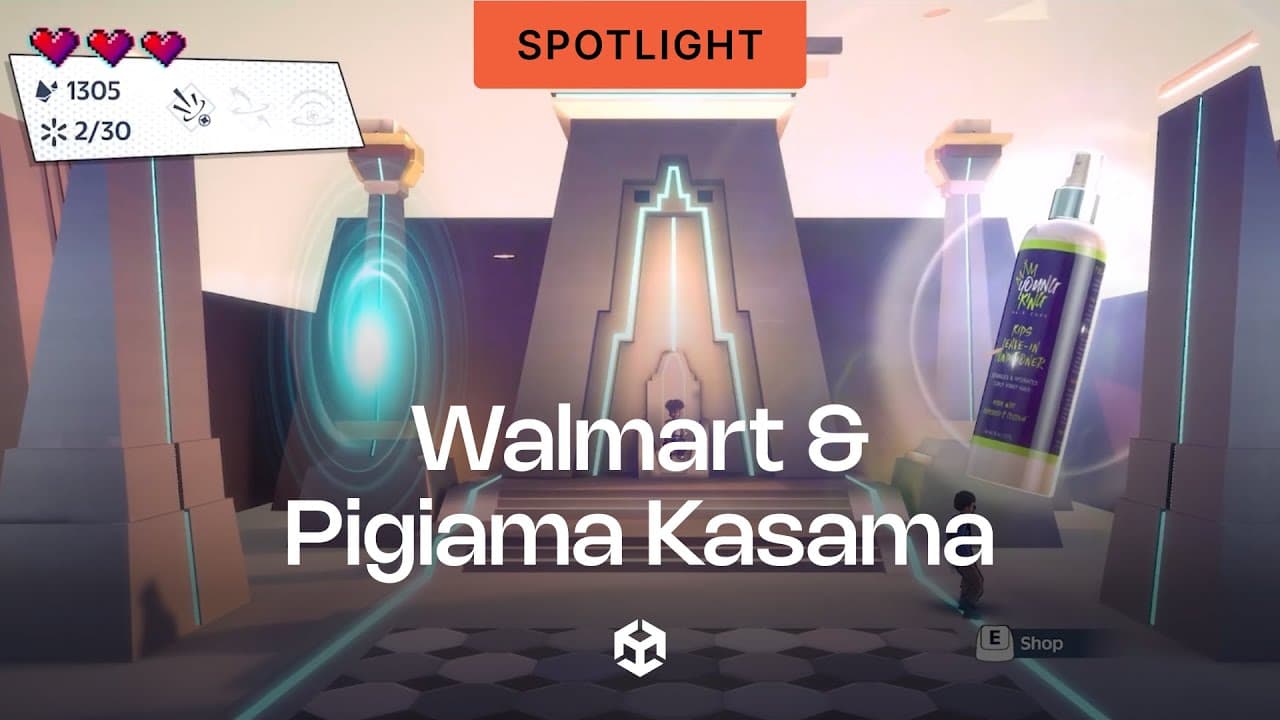
RO: The minigames that we worked on with Pigiama Kasama, those were a combination of my team's technology and of course, their creative in-game development expertise, as well as the Walmart marketing team. And that initiative, led mostly by the marketing team, was to get some event-based brand and product launches in front of customers in those spaces. The interesting thing about the Pigiama Kasama integration is that you actually see digital twin products in the space. And so it's a very carefully crafted experience where your avatar can come up to the products and interact with them, see the 3D objects floating in the world, and then if you choose to, you can initiate a product inspection and a transaction flow.
PS: Walmart Unlimited is a series of three games, each and every one covering a different story. The protagonist of every episode is a vendor and entrepreneur from Walmart. And the interesting thing that happened is that it's very much community-driven. The stories are true stories, of course mixed with a little bit of fiction. Each episode talks about a different story and different objective, and also has a very different art style and slightly different gameplay.
Unity as a game engine has many perks. The flexibility is definitely one of the strongest suits but also, and this is very important for our business, the capability of being very fast with prototyping and proposing solutions for proof of concept or validating ideas. Unity is not per se an engine that is focused on doing one thing, but it's very much an open book. So you can tune it and you can turn the knobs to achieve exactly what you want.
A partnership for the future
RO: It's always fun to have something, you know, even an early experiment, ship so that you can get the reactions, not just from the customers, which were great, but also to be able to show something like that off internally and kind of get the executives to go, wow, you know, this is a real thing. And to wrap their heads around what it means to put commerce in games as a channel.
PS: Working with Walmart was great. My favorite part was their willingness to do a real game. Pigiama Kasama has always, in a way, disliked the idea of making a game for promotion, for the sake of it. We are gamers ourselves, and we truly value the quality of the game and gameplay. When we realized that Walmart was very serious about doing a real game, well, that made us very happy, and I think the results showed that.
The moment where we are most surprised is not during development, but at the end of development. When we see people enjoying and being surprised and happy about what we did, this is probably the most surprising wow moment of the whole production.
RO: Walmart is in a great place to be able to solve this. Unity is the perfect partner to work with to find it.
PS: Unity in three words: freedom, efficiency, and flexibility.
This transcript has been lightly editorialized for readability.


