How Ghost Town Makes VR Movement Feel Natural

Unity Team - Unity Technologies

Check out our interview with Fireproof Studios producer Tom Seed and director Barry Meade where they explain how they evolved their VR design in Unity for Ghost Town. They show how soft guidance and detailed environments support free-form navigation and deepen player immersion. See how high frame rates and customizable comfort settings improve accessibility for more players.
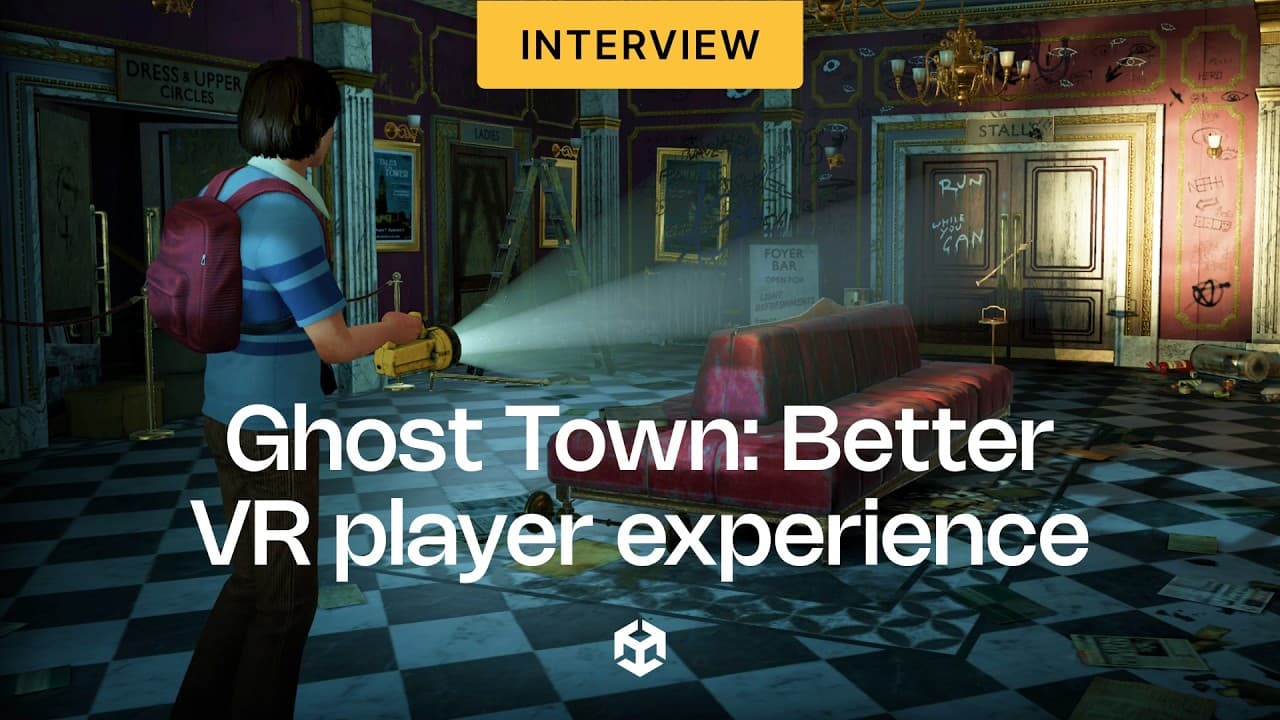
TOM SEED: Ghost Town is a VR puzzle adventure game set in 1980s Britain. It follows the protagonist, the player character, an Irish witch called Edith Penrose, as she kind of tries to track down her missing brother.
BARRY MEADE: Because we made The Room VR, we had experience of doing VR in earnest.
TOM SEED: Every game that we make, we always want to be more ambitious with the next project.
BARRY MEADE: But with Ghost Town, we specifically wanted to make a sort of puzzle adventure game where the player moves through an environment and has to navigate for the first time, which wasn't really part of The Room VR.
And exploration wasn't part of The Room VR either, and so we felt like if we went into a freeform game where there was an actual environment to move through, that we could enhance that and give a better experience to the player than we had with The Room VR.

Ghost Town | Fireproof Studios
GUIDING ATTENTION THROUGH DETAIL
TOM SEED: Certainly our line of sight is something that, you know, is always a consideration in VR. We don't have control of where the player is going to be looking at any moment in time, so we try and kind of direct them as best we can.
Because, yeah, we never take the camera away from the player because it wouldn't be very pleasant at all.
BARRY MEADE: It's about a sort of a soft guidance of the player, where you're constantly, I don't want to say manipulating, but you are manipulating where the player can look and go and see, but yet you absolutely want them to have the experience of moving through this space themselves on their own terms, at their own speed.
So, players, for instance, love to look in VR. In a flat game where you would build an environment, and say the player has to get from A to B, the player’s goal is B, so they're not necessarily looking around at what's around them, but in VR, there's a massive incentive for the player to just stop whatever they're doing, to just look at something.
So, we realized with The Room VR that detail mattered in the environment. So, that was one of the things that we tried to incorporate into Ghost Town. Although every environment we made was pretty big, it was also detailed and that there was always something to look at, something interesting to hear, to read, to pick up at any one stage.

Ghost Town | Fireproof Studios
BALANCING IMMERSION AND COMFORT
BARRY MEADE: In VR, there's whole other things that can happen to stop the player feeling comfortable.
TOM SEED: Obviously, movement in VR can be quite nauseating in some cases, but we try our best. Obviously, you're on a boat, it's not rickety or bumping around at all, it is very flat, but you still get the impression that, oh, I'm standing on a boat in the middle of the ocean in VR.
BARRY MEADE: So, we are constantly, in a way, taking things away from the player so that they get the right experience, right? And so, as Tom said, a perfect example is that when you're on a boat, it doesn't bob. Whereas, if you wanted to make something truly immersive, you would make the boat bob up and down so that it matches the sea, for instance. But you don't want to do that in VR.
You have to smooth everything out for the player so that they don't ever have these issues come up. Obviously, high frame rates are really important to keep back the sense of nausea, but you also put in a lot of limiters for the players.
So, if you've got really good VR legs, you can get rid of all of the guides and the hand holding that we do for the player. We've got things like vignettes. We've got step movement for people who don't like continuous movement, that kind of thing.
So, we always try and make our games tailored to the kind of player that each individual is. Every game we make, we want everyone who starts the game to finish the game. We have no interest in beating the player at all.
We want them to see everything in the game, so we do everything we can to make sure that if a player is stuck for any reason, there is a way through things and a way around them or that they could just adjust something in the menus to make it easier for them. Because yeah, like I say, we build our content to be seen.
Check out more stories from Unity developers on the Unity Blog and Resource Hub.