How game technology is revolutionizing collision repair training

Mike Mertes, with more than 25 years of experience spanning the video game and music industries, understands how game development can shape and inform broader applications across various enterprises. From his beginnings as a freelance video game journalist to contributing as a producer on diverse game development projects, he has always been inspired by the ripple effect the game industry has on the world. Today, this rich foundation drives his role at I-CAR, where he leads the Learning Innovation and Technology team, pioneering the use of Virtual Reality (VR) to transform collision repair training.
This is the story of how game design principles pivot seamlessly into enterprise use cases like the collision repair industry, the challenges tackled, and the breakthroughs achieved in creating immersive, hands-on learning experiences for the automotive industry.

Game start: Enterprise edition
When I joined I-CAR’s efforts to enhance its automotive training curriculum with VR-based simulations, it felt oddly familiar. It was a lot like setting up a new game studio, except instead of launching video games, the focus was on creating impactful educational tools for technicians to use in the collision repair industry.
I-CAR (Inter-Industry Conference on Auto Collision Repair) is a not-for-profit organization dedicated to advancing the safety, efficiency, and quality of collision repairs. With a solid reputation since its founding 1979, and setting the education standard for excellence in collision repair with its Gold Class recognition program, it is an ideal platform to explore something as forward-thinking as VR learning integration.
The complexity of bridging the virtual gaming technology and automotive repair worlds was a challenge I was ready to take on–with my previous experience and lots of research, I began the journey to build the foundation for what would become I-CAR's Learning Innovation and Technology team.

Selecting the Engine
Selecting the right development engine was the critical first step in building our VR-based training simulations. While I've experimented with various game engines during my time on several game projects, my bread and butter of game engine development has been Unity for almost 20 years. Along with my own experience, I spoke extensively to other companies developing for Virtual Reality, and the most common factor with all of them was that they were using Unity. In terms of stability, Unity’s integration with OpenXR and Meta XR All-in-One plugin could not be beat. The overall flexibility of the engine would allow us to quickly shift to other SDKs in the future if needed.
Another key consideration was Unity Version Control. With much of our team working remotely, we required a robust system to manage project backup, retrieval, and development workflows. It was essential to have a solid version control system that would allow us to easily roll back changes or create branches for different development paths if needed.
With Unity meeting all of our development requirements, the choice was straightforward. Looking back, it’s proven to be a pivotal decision, playing a significant role in our team’s success and the continued progress of our development efforts.
Building a team of VR innovators
Once the engine was selected, the search for an internal development team began. During our search for Unity developers, it was remarkable to see many candidates accomplishing incredible things with the Unity Engine. My game industry knowledge, combined with a clear understanding of our educational goals, proved helpful in bridging the gap for candidates from the game industry. This allowed me to show them how their development skills could help forge a new, exciting way of learning for those in the collision repair industry.
To ensure that the 3D models in our experiences are accurate and visually appealing, we also hired a 3D modeler. Our 3D modeler had never used Unity before, but thanks to collaboration with our Unity developers and the diverse learning catalog of Unity Learn, she was quickly able to get our 3D assets into Unity and functioning in a high-quality manner.
Our comprehensive team comprised of Unity developers, 3D animators, and XR subject matter experts. With these talents, we could ensure all development, experience accuracy, VR headset knowledge, and all-important QA testing would be closely monitored to ensure success with the prototypes. Once the team was in place, it was time to begin scoping out exactly what content the VR prototypes would contain and how creating them would fit into I-CAR's well-established curriculum creation process.


Building the Prototypes
We worked closely with I-CAR’s Product Development and Curriculum team to integrate VR seamlessly into their course design process. Together, we quickly developed an interactive step sheet aligned with existing outlines and storyboards, capturing key process skills from real-life repair procedures. The step sheet also served as a tracker for required 3D assets, interactions, sounds, and other elements to be authored in Unity for the VR experience.
Introducing VR into a curriculum team unfamiliar with the technology was as much about education as creation. To illustrate VR’s potential, we developed a small prototype in Unity to use on a Meta Quest 2 headset. Developing this training prototype for the curriculum team allowed the development team to get all our baseline production process in Unity established. With things like how to import our 3D assets into Unity and several pieces of code written for interactions, we now had a development template for our main prototypes. The developed VR training prototype allowed curriculum team members to interact with the tools and vehicles, gaining firsthand insight into the power of immersive 3D experiences.
This small development was a smashing success that not only boosted team buy-in, but also evolved into a VR trainer that could help new learners familiarize themselves with VR before jumping into more complex prototypes. The success enabled us to focus on translating real-world processes into powerful, virtual experiences that felt natural, engaging, and accurate to technicians.
Video courtesy of I-CAR
Bridging gaps with immersive learning
Imagine this scenario: You're about to take a class on handling the high-voltage systems contained in an electric vehicle (EV). Before this class, do you have any experience with:
- Using a multimeter
- Measuring for voltage
- Using a two-pole tester
- Safety procedures
- Performing a high-voltage disconnect process
Walking into a class to be taught these topics might seem pretty daunting, and if you are anything like me, you'd be looking at YouTube videos or any other resource to get a better understanding of the processes before the class. It's a confidence thing. Who doesn't want to have some prior knowledge of what they are about to walk into when it comes to complex processes?
Here's the tough spot: While there may be some resources out there, all of the processes mentioned require hands-on experience to understand them. Do you have a multimeter and two-pole tester accessible and, with that, something to measure voltage? What can you work on that's safe but also relevant to the process of working on an electric vehicle? What about cost and general accessibility?
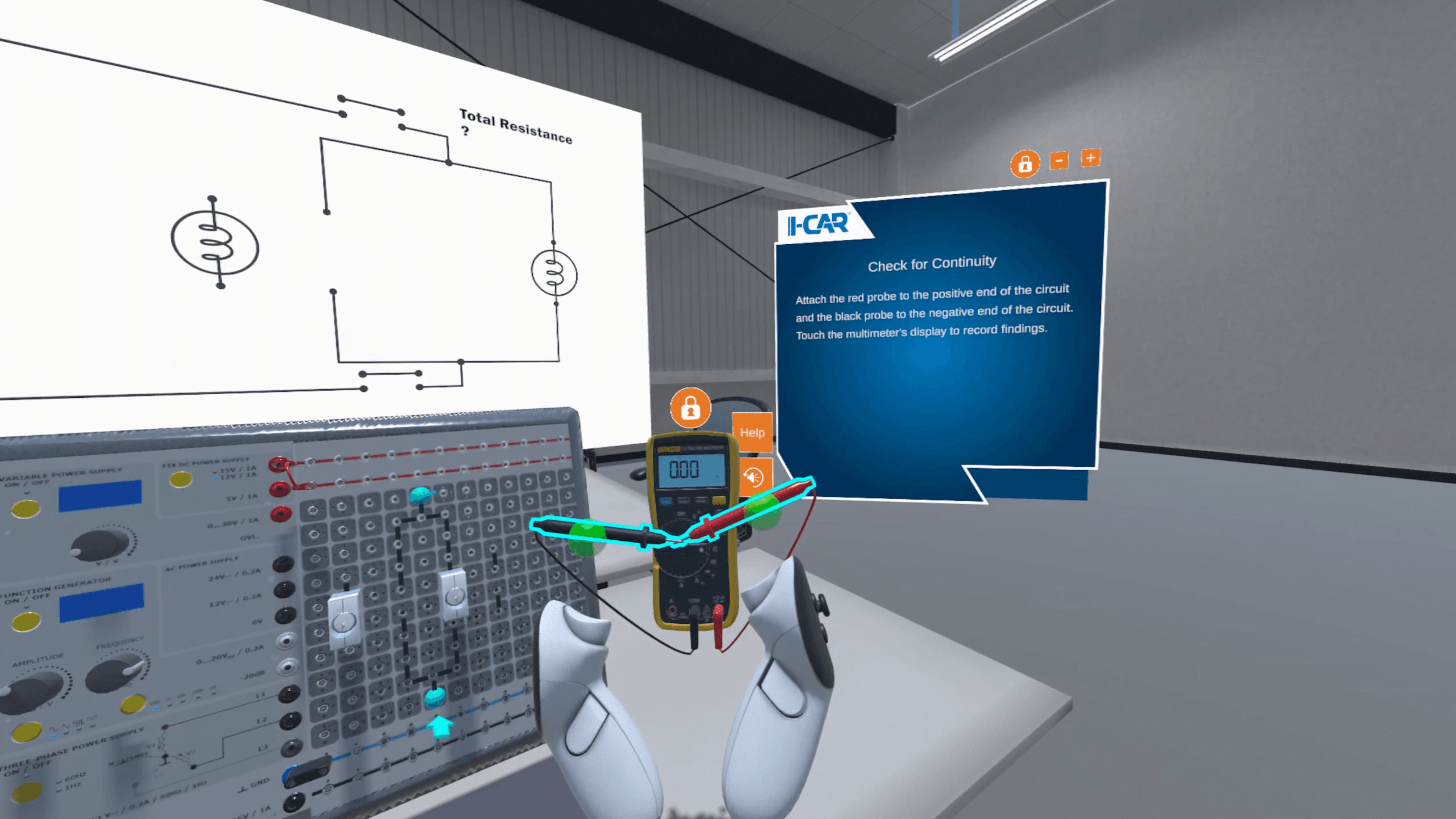
Enter VR. It bridges these gaps by offering hands-on exposure to these processes, without the safety risks or costs of practicing on real equipment. Learners can put on a headset and are instantly transported to the virtual training lab. Here, they can:
- Learn to safely measure voltage with a multimeter.
- Practice high-voltage connection procedures.
- Repeat steps endlessly until they are confident in their skills.
This technology allows learners to make mistakes and learn from them in a safe and controlled environment. Once they feel that they have mastered the training, they can transition to the real-world applications and feel not only prepared, but excited to showcase their newly acquired skills and knowledge hands-on.
A glimpse into the future
After showcasing our prototypes within the collision repair industry and at major industry events like SEMA and CES, we received overwhelmingly positive feedback from automotive professionals. The interest and encouragement gave us the green light to convert our designed prototypes into full VR-based courses. Two of these courses, focused on detailed aspects of working with electric vehicle technology and troubleshooting ADAS-related repair scenarios, are scheduled for launch in late 2025.
While VR won’t replace all aspects of hands-on learning, it excels at making complex, inaccessible, or expensive scenarios more approachable. It’s a tool–one that complements traditional training methods by offering learners a safe, scalable, and interactive way to master skills. By leveraging platforms like Unity Industry, businesses can create immersive VR experiences that redefine the future of training and help make advanced learning experiences more impactful.


