How Titanium Court’s storylet system powers big stories

Unity Team - Unity Technologies

After much buzz and a Seumas McNally Grand Prize win at the Independent Game Festival (IGF) Awards, solo dev AP Thomson’s new Made with Unity Titanium Court launched last week.
Check out our chat with AP, captured during GDC week, to learn about this new strategy game and the tools he created to power its unique, dynamic storytelling, in AP’s own words.
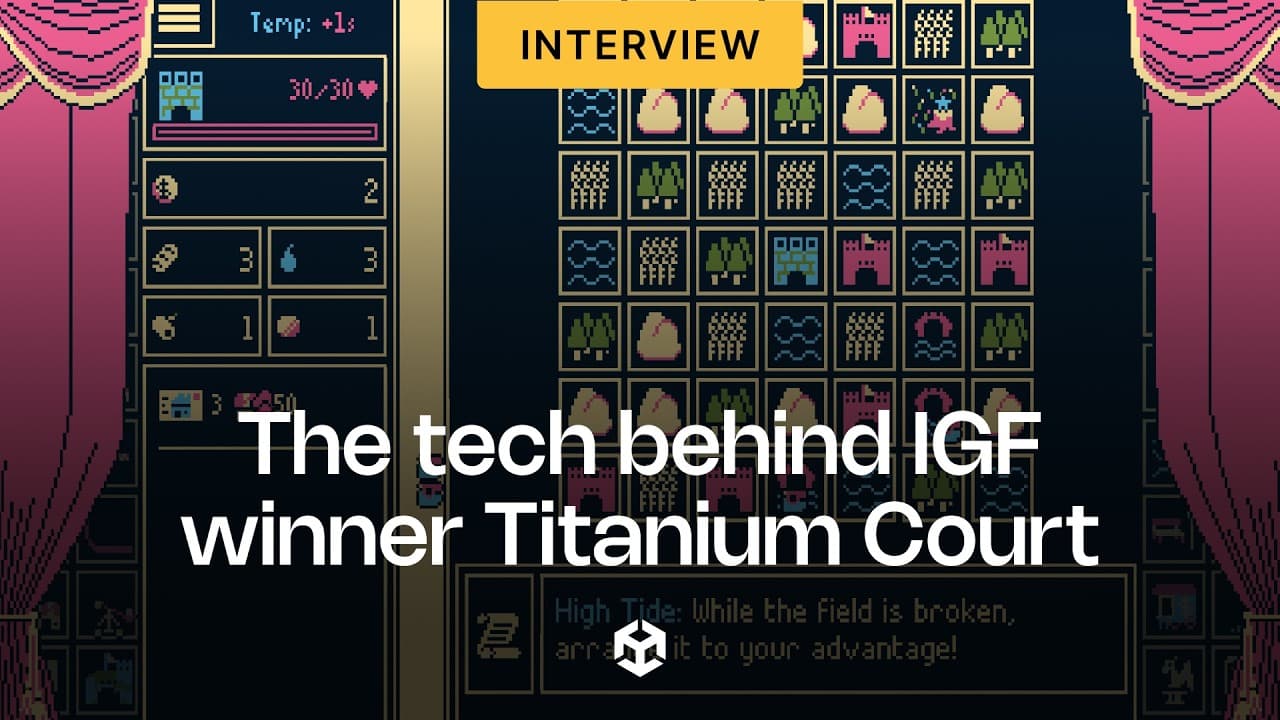
AP Thomson: What is Titanium Court about? That, as it happens, is a very difficult question to answer.
It is a world of fairies and magic, but the magic in this world is maybe more mundane than you might expect, and the mundane aspects of this world are more magical than you may expect.

Titanium Court, by AP Thomson
CREATING A STORY-FIRST GAME
Titanium Court is a weird blend of a lot of different genres. So it's got a little bit of Match Three in there. It's got little bit a tower defense in there, it's a little of resource management and a little economic simulator, arson simulator. There's a lot things happening in this game. And it is also a narrative game with a lot of reading in it and the narrative is paced in a really interesting way. It's kind of like you've got roguelike runs that are interspersed with a narrative that proceeds regardless of whether you win or lose.
I think this is a game for people who like to read, which unfortunately, various college professors I know have been telling me that that is something people don't really know how to do anymore.
It is worth learning to read for.

Titanium Court, by AP Thomson
BUILDING TOOLS FOR DYNAMIC STORYTELLING
The narrative design of Titanium Court uses what is now kind of commonly known as a storylet system. I had never heard of the term storylet when I first came up with it –
You can think of it as an individual scene.
The kinds of stories that a storylet system really empowers are like very dynamic stories where some things may happen or some things may not happen depending on what has actually happened in the game.
So it lets you design the narrative, and the way I referred to it was message in a bottle design, where basically I can open up a scene file, write everything you need to know about the scene, including where it actually happens in the game, and then just put it in the bottle, throw it out into the ocean, and then possibly weeks later, I'll be playing the game and the scene will happen.

Titanium Court, by AP Thomson
MANAGING STORYLETS IN UNITY
So I have characters who move around or little art portraits that pop up in certain moments. And these are all contained in a single scene that exists in a JSON scripting file. And also inside this file is a bunch of metadata talking about where does this scene show up in the game. So we've got information like this scene should show up in this chapter, or this scene should show only if you've seen these other scenes, or this seen should show up only if you have accomplished certain things within the game.
It lets you handle, I guess, complex webs of dependencies.
It's got a locking system built into it to prevent too many scenes from triggering at the same time. So I've got this system where one of these scenes I might tell it, go ahead and lock what these characters are doing.
It kind of starts as an individual script file. So it's like a JSON file where I fill out all the dialog and stage directions and also the metadata. But then I hand that over to a pre-processor script inside the Unity Editor that I wrote that just goes through all of those JSON files and transforms all of them into prefabs and populates the prefabs with. The correct data, like various different boolean flags and stuff so that, and then all of those prefabs kind of get indexed into a single central indexing object that is then able to handle the actual technical implementation of choosing the correct scenes at the correct time.
This kind of system doesn't necessarily make it easier to keep track of a large amount of backstory just because you are working with a lot of scenes that are kind of separated from each other and you don't have like a single Bible or document that is saying, here's what happens in this order. Now, that's what we want because we want a system that reacts dynamically to what is happening with the player, but it can also make it a little bit trickier to have a perfect idea of what order things are going to happen in.
So it's a really kind of modular way of organizing your narrative scenes inside the game.
Explore more Made with Unity games on our Steam Curator page, and check out more stories from Unity developers on the Unity Blog and Resource Hub.