Making autonomous driving accessible to all with Unity: TIER IV’s AWSIM open-source simulator

TIER IV is working to make autonomous driving accessible to all by opening up development to improve accessibility and scalability. To support that vision, the company built AWSIM, an open-source simulator developed with Unity that helps teams test, validate, and optimize Autoware - open-source autonomous driving software - in a more realistic and efficient environment.
In this interview, AWSIM development lead Takatoki Makino explains why TIER IV chose Unity, how the team built a simulator tailored to autonomous driving, and how AWSIM is helping expand the Autoware ecosystem while reducing reliance on costly real-world testing.
Key takeaways
- TIER IV built AWSIM, an open-source autonomous driving simulator developed with Unity to provide a realistic, Autoware-compatible simulation environment for testing and validation.
- Unity enabled faster development, high-performance autonomous driving simulation, and flexibility across Linux-based, Ubuntu-centered workflows used by Autoware teams.
- AWSIM lowers barriers to simulation adoption, expands the Autoware ecosystem, and reduces reliance on costly, risk-prone physical vehicle testing.
The limitations of traditional methodologies
Developing autonomous driving software requires simulation environments that can accurately validate behavior, sensor performance, and system interactions at scale before on-road testing. Real-world testing with vehicles and specialized courses is costly, time-intensive, and carries inherent safety risks.
But when TIER IV evaluated existing simulators in 2020, they found that they were not designed for the needs of autonomous driving software like Autoware. Many relied on proprietary protocols instead of ROS2-compatible communication, making realistic integration difficult and increasing the effort required to move between simulation and real-vehicle environments.
Technical limitations created additional friction. Some simulators processed LiDAR on the CPU, which reduced speed and accuracy, while others lacked essential capabilities needed for autonomous driving workflows, including reliable traffic signal recognition in complex intersections. As a result, TIER IV could not find a single simulator that supported a complete Autoware simulation process end to end.
AWSIM as a reference environment
Rather than stitching together multiple incomplete tools, TIER IV chose to build its own simulator: AWSIM. AWSIM is an open-source autonomous driving simulator built with Unity and designed as a reference environment for Autoware. Developed with Unity, it integrates cleanly with Autoware and supports a more open development model for the broader autonomous driving ecosystem.
Its open-source foundation was a strategic choice. By making AWSIM transparent and accessible, TIER IV created an environment where companies, researchers, and developers can more easily participate, contribute, and build on a shared reference implementation.
AWSIM also reduces the learning curve for teams adopting Autoware. Pre-integrated demo simulations make it easier to connect the simulator and begin running end-to-end workflows without the heavy setup work typically required to configure sensors, maps, and scenarios. In this way, AWSIM serves not only as a simulator, but also as a practical reference for how Autoware-compatible simulation environments can be built.
Mr. Makino said, “Moving forward, AWSIM will map a course as a reference for companies and universities involved with autonomous driving that are looking to develop simulators aimed at connection with Autoware. I hope this leads to a variety of different collaborations in the future.”
Five reasons Unity was selected as a development tool

Image caption: AWSIM development screen
To build AWSIM, TIER IV needed a development platform that could support high-fidelity simulation, complex sensor workflows, external integrations, and rapid iteration from prototype to production. After evaluating the options, the team selected Unity for five main reasons:
1. Faster development and prototyping
Unity’s built-in physics, rendering, and scene management helped TIER IV focus more on implementation and less on foundational setup. According to Mr. Makino, Unity’s C#-based environment also supported faster R&D iteration across sensor and vehicle behavior experiments.
2. A strong balance of core and advanced capabilities
TIER IV valued Unity’s combination of mature foundational tools and extensibility, including technologies such as the data-oriented technology stack (DOTS) and the Scriptable Render Pipeline (SRP), which supported more advanced optimization and customization.
3. Performance and flexibility at scale
Autonomous driving simulation places heavy demands on rendering and object processing. Unity gave the team flexibility to tune for quality or performance and efficiently manage large numbers of moving objects such as vehicles and traffic participants.
4. A large ecosystem and talent pool
Unity’s broad user base, documentation, support resources, and adoption beyond gaming made it easier for TIER IV to access knowledge, solve problems, and hire talent with Unity experience.
5. Multi-platform support for open development
Because AWSIM is open source, accessibility matters. Unity’s Linux support made it a strong fit for the Ubuntu-based development environment used by Autoware and AWSIM, including CI pipelines and containerized workflows.
The challenges of open source and autonomous driving simulators
Building an open-source simulator for autonomous driving introduced a distinct set of technical and operational challenges for TIER IV and the wider Autoware community. Because AWSIM would be publicly available, TIER IV had to work within the constraints of open-source-compatible libraries and external assets.
To address this, TIER IV collaborated with Robotec.ai, a member of the Autoware Foundation industry group, to develop and use libraries such as ros2-for-unity and Robotec-GPU-Lidar. These helped enable native ROS2 handling in Unity and ray-tracing-based LiDAR simulation using NVIDIA OptiX, offloading LiDAR processing from the CPU to the GPU.
The team also had to solve Ubuntu-specific development requirements. Since Autoware runs on Ubuntu, AWSIM needed to do the same, even when external device support was limited or undocumented. In cases such as steering wheel controllers that lacked native Ubuntu support, TIER IV developed custom drivers to bridge the gap and keep Hardware In the Loop Simulation (HILS) setups consistent.
“Using game engines like Unity for a rapidly progressing development is incredibly effective for industrial and research purposes.”

Takatoki Makino - TIER IV
Simulation EngineerSolutions for the key challenges

Image caption: Imaging Unity output with an actual camera sensor
Multi-camera rendering
Autonomous driving simulation creates performance demands that go beyond typical interactive 3D applications because every frame must feed multiple high-resolution sensors in real time. In some AWSIM scenarios, TIER IV needed to run eight or more cameras simultaneously while preserving sensor fidelity, a requirement that made standard optimization techniques insufficient on their own without custom tuning.
Using Unity, the team developed a set of specialized optimizations to manage this load. These included staggered rendering across cameras to reduce spikes, time-scale controls to allocate more resources per frame, asset optimization, and rendering pipeline flexibility within a single project to balance accuracy and frame rate.
Hardware in the loop simulation
TIER IV also used tools such as the Unity job system and PhysX to improve real-time performance for vehicle, traffic, and pedestrian simulation. To support hardware-in-the-loop simulation, the team went further, analyzing raw sensor packets and reproducing equivalent output from Unity so they could test with ECUs and camera sensor setups in the loop before deploying to test vehicles.
“The culling and LOD used in normal game development can change surrounding objects, which can affect the sensor data we are able to collect. This is why we needed to come up with a number of ideas to get the performance we wanted.”
Takatoki Makino - TIER IV
Simulation EngineerFunction development using libraries
TIER IV extended Unity further through custom and co-developed libraries. The team built a ray-tracing LiDAR capability using NVIDIA OptiX, connected it to Unity as a native plugin, and used it to generate point cloud maps for Autoware’s self-positioning workflows. They also used VFX Graph to simulate weather effects such as rain and snow, including the visual noise these conditions introduce into camera and LiDAR data.
With the ros2-for-unity library, TIER IV was able to work more directly with DDS and ROS2-related settings inside Unity, helping unify time management across the simulation stack and reproduce low-latency communication patterns closer to those used in real vehicles on the road.
“‘ros2-for-unity’ enables as-is high-throughput low-latency utilization of the messaging formats and communication protocols used in actual cars, which allows us to reproduce simulations that are as close to real cars as possible.”
Takatoki Makino - TIER IV
Simulation EngineerAWSIM developments contribute to improvements in Autoware

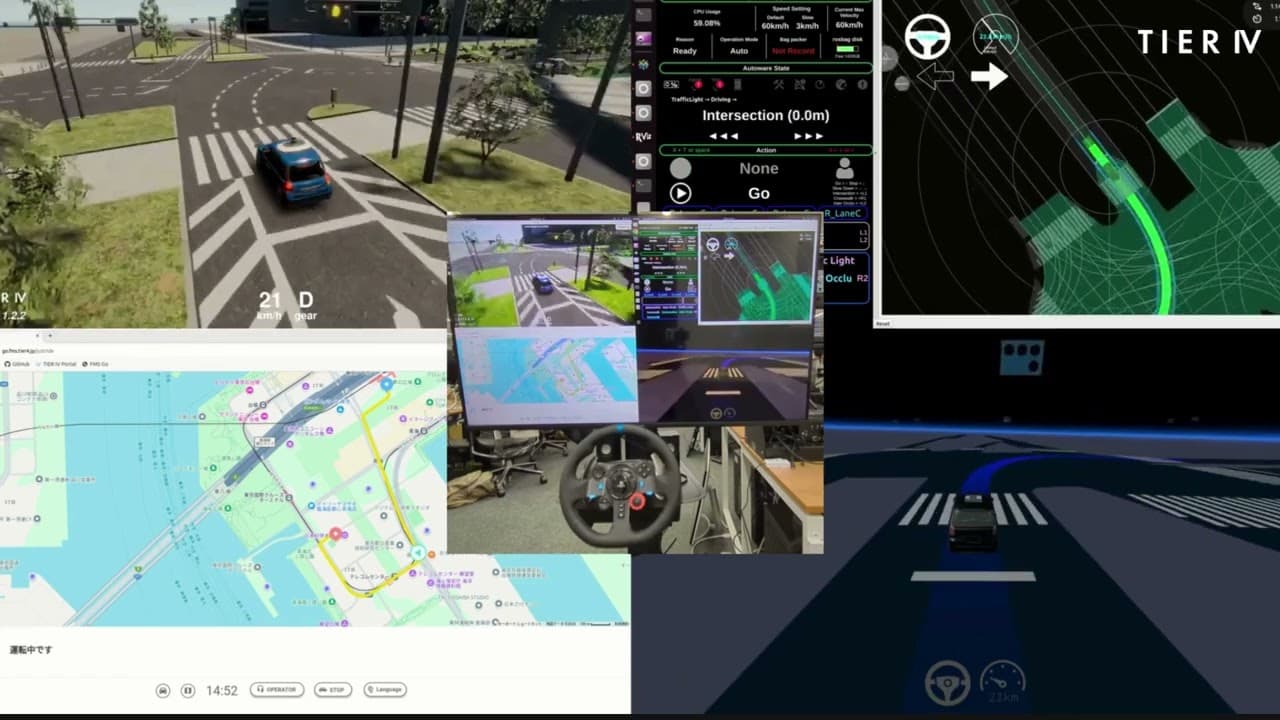
Image caption: Integrated simulation, including periphery Autoware tools - Upper left: AWSIM, Upper right: Autoware, Lower left: Driving route, Lower right: In-vehicle app
AWSIM delivered value both to the external Autoware ecosystem and to TIER IV’s internal development workflows. Before its launch, running simulations required deep knowledge of both Autoware and the simulator itself, creating a high barrier to entry for new participants. AWSIM lowered that barrier by making it easier for developers to get started and run simulations through tutorials and pre-integrated workflows that show complete Autoware pipelines.
That accessibility helped expand adoption. AWSIM has also been used in the AI Challenge preliminaries run by the Society of Automotive Engineers of Japan, exposing hundreds of participants each year to the Autoware ecosystem and helping accelerate community growth around open-source autonomous driving.
Internally, AWSIM improved development efficiency by supporting end-to-end evaluation before Autoware releases and reducing reliance on physical vehicles for early validation and debugging, especially for camera-based functions such as lane keeping and traffic signal recognition.
The impact of AWSIM extends beyond internal testing efficiencies to broader industry validation. In 2025, the project was named the Industry Innovation Award winner at the 17th Unity Awards, reinforcing TIER IV’s success in driving the autonomous vehicle sector forward through accessible, open-source simulation.
“The most important accomplishment of AWSIM is that it allowed us to create an environment in which anyone can connect a simulator to Autoware just by watching AWSIM tutorials.”
Takatoki Makino - TIER IV
Simulation EngineerThe future of AWSIM
Looking ahead, TIER IV plans to continue advancing AWSIM as a digital twin simulator reference for Autoware projects. One major goal is to use highly accurate reproductions of proof-of-concept testing sites to generate tens of thousands of kilometers of driving data, enabling more large-scale evaluation without relying solely on real-car testing.
For TIER IV, that means more than improving simulation quality. It supports a broader vision: strengthening Autoware’s reliability, expanding its global community, and moving closer to an open autonomous driving ecosystem with worldwide reach for developers, researchers, and industry partners.