Making ports safer with simulation training

Discover how HR Wallingford helps improve vessel pilot skills and reduce training program delivery time for many ships and ports with simulation technology.
Overview
Create visually realistic, effective, and tailored simulation training in weeks instead of months.
Solutions
Unity Industry with Industry Success
Team members
3 visual modelers, 1 naval architect, 3 developers
Locations
Wallingford, UK and Fremantle, Western Australia
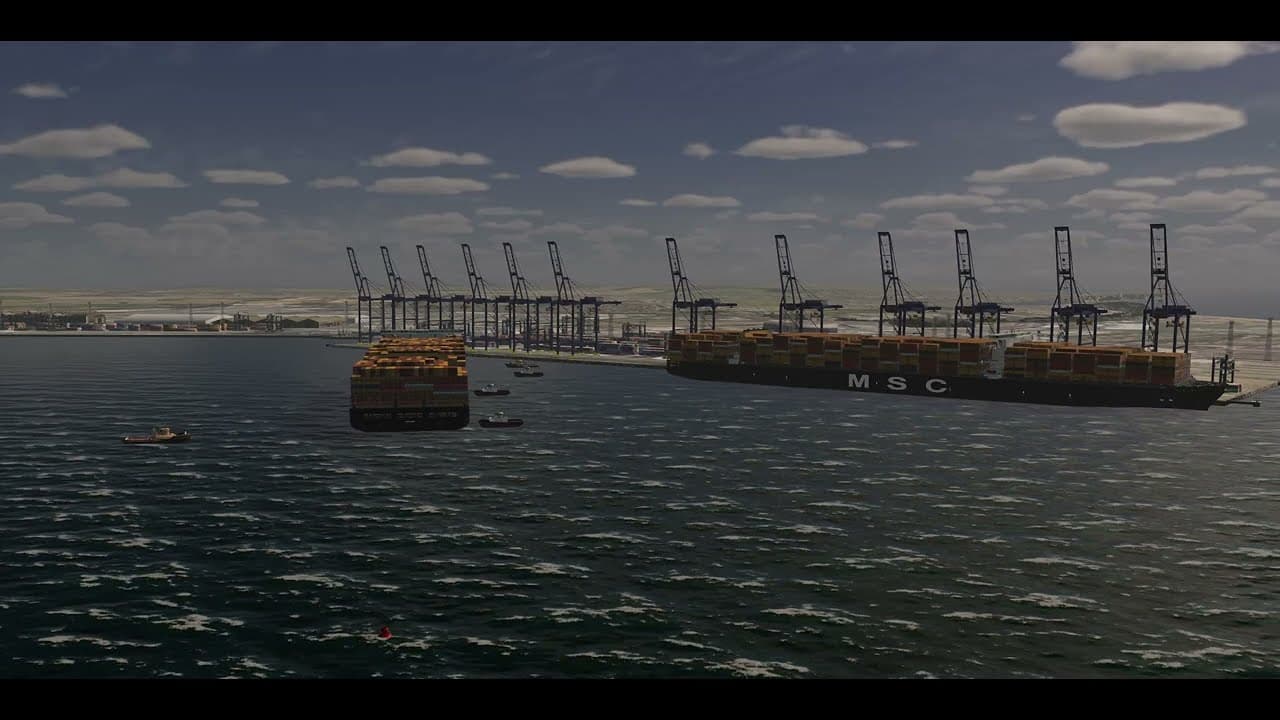
Approximately 90% of world trade is transported by the international shipping industry. When the Suez Canal was accidentally blocked by a cargo ship in 2021, a daily estimate of $9.6b of goods were delayed.
Effective pilot training is critical to ensure massive cargo ships can safely navigate through complex locations.
The solution: An upgraded training simulator for the UK’s busiest container port
Harwich Haven Authority (HHA) partnered with HR Wallingford to provide simulator based training, which:
- Allows for training in adverse weather conditions at the port’s operational limits.
- Provides continued professional development programs, including tailored training, which allow the required proficiency levels to be achieved and maintained in a timely manner.
- Enables pilot familiarization for new vessel classes before their first call at HHA.
- Encourages best practices to be developed and promulgated throughout the Port Authority.
- Allows an independent assessment of towage requirements (tug capabilities and numbers).
Learn more about HR Wallingford’s training simulator and find out how one of their customers, HHA, uses it to manage a port handling over 35,000 vessel calls each year – around 40% of UK container traffic.
“The support provided with Industry Success has made a big difference.We've made more progress working with our Customer Success Manager than during the previous two years.”

James Clarke - HR Wallingford
Technical Director, Ships and DredgingWhat are the challenges of conventional training?
Risk
With each container vessel carrying up to 24,000 twenty-foot equivalent unit (TEU) of containers, or 146 km of containers stacked end-to-end, and the risk of a marine incident temporarily closing a port, on-vessel training must be carefully managed. Only simulation training allows training to be carried out in limiting conditions without risk.
Availability of vessels
On-vessel training requires access to a range of cargo ships that increase in size as the trainee progresses or as new vessel classes become operational. With simulator training it is possible to carry out training before a new class of ship calls at the port or even before it has been launched.
Slow technology development
Conventional 3D pipelines do not allow for:
- Incorporating third party physics models (such as those made by HR Wallingford).
- Making real-time updates to meet changing vessel or port specifications.
- Creating realistic visualizations of the marine training environment.

Why did HR Wallingford upgrade to Unity Industry?
HR Wallingford chose to upgrade to Unity Industry after using Unity Pro for two years. For Technical Director, Dr. James Clarke, there was one major driver to make the change: Industry Success (IS). With guidance from their dedicated IS advisor, HR Wallingford was able to quickly achieve key objectives, including:
- Upgrading to High Definition Render Pipeline (HDRP) from the Built-in Render Pipeline for more realistic wave simulation.
- Implementing real-time changes, such as integrating numerical wave models into the simulator visualization.
- Increasing flexibility to more easily customize simulations for each client.
As Dr. Clarke says, “We need a very high level of expertise to feed into technically challenging simulations. Therefore we need to make the best possible use of industry tools, to avoid reinventing the wheel, but to also be able to apply our own hydrodynamic and metocean modeling.”

HR Wallingford’s pilot training takes place in a fully simulated bridge environment.
Explore the simulators
HR Wallingford’s Ship Simulation Centers combine hydraulic modeling research, vessel maneuvering models, and expert experience from naval architects, master mariners, and more.
The simulators replicate a vessel's bridge in real-time, recreating spatial and temporal vessel behaviors. Realistic aesthetics are key to a credible training scenario. With visual cues such as parallax reference points, serving as tools for pilots, it is essential that the visual environment be accurate. Sophisticated numerical models of the wind, waves, and currents are also included to provide realistic environmental forces.
The simulators can be run individually or simultaneously, allowing multiple interactions at a time. This is important, as large cargo vessels are routinely supported by four or more tugs.

On-screen playback can be reviewed instantly, providing a discussion point for the pilots and trainers.
“Traditionally Pilotage has been carried out visually and accurate visualization is essential for effective training. Increasingly it is necessary to blend traditional techniques with modern navigation aids. Simulation is an essential tool.”

William Barker - Harwich Haven Authority
Marine Director (Harbour Master)Effective learning with instant feedback
Simulator training allows trainees to try, fail, learn, and try again in a completely confidential environment, without any negative repercussions. Pilots can complete simulation scenarios that allow them to assess themselves and identify areas for improvement, while also serving as a catalyst for round-table discussions and constructive feedback based on the port’s best practices. Procedures developed in the simulator can be combined with practical experience and put into practice on the water.
Upon completion, the team gathers to debrief, using the on-screen playback of the session. Within minutes, the system can be reset to run another simulation.
Pilots from HHA spend a minimum of 2 days a year on the simulator as part of their Continuing Professional Development program.
Beyond pilot training
For HHA, the simulator is not just about providing training for existing pilots. It is also used in other initiatives, including:
- Assessing the aptitude and attitude of potential future hires.
- Supporting HHA’s goal of making careers in marine pilotage more inclusive. HHA regularly participates in demonstrations of simulation and Pilotage for visitors from educational and professional bodies.
- Assisting in port planning and strategic port developments.
Looking to the future
Upgrading to Unity Industry has allowed HR Wallingford to develop simulator training more quickly than expected, without the need for significant recruitment investment. They are working alongside the Industry Success team towards their next goals, such as:
- Implementing more realistic night-time simulations using HDRP.
- Meeting specific customer requirements, like representing soft grounding events, in the simulator.


