Building a culture of collaboration: A strategic guide to digital workflow excellence

Harnessing communication strategies and integrating collaboration-focused technology to generate trust, improve workflows, and increase efficiency
Digitalization has transformed the way we work, allowing teams to process vast amounts of data from anywhere. However, without a strong foundation of collaboration, this sea of information can overwhelm rather than empower. Disconnected users miss crucial details, creating tangents that slow progress and lead to inefficiency. Despite an abundance of powerful tools, a lack of unified direction allows silos to form and old inefficiencies to persist.
To realize the promise of this digital revolution, organizations must strategically integrate communication and workflow strategies with a technology stack that centralizes data and fosters trust. This isn't just about efficiency; it's about driving a higher return on investment by unlocking your team's full potential.
In this e-book, you will learn how to:
- Understand communication barriers: Identify and dismantle cognitive and structural roadblocks that hinder effective teamwork.
- Select the right technology stack: Understand how different solutions like DAM, PLM, and CMS can be combined to create a seamless, collaborative ecosystem.
- Implement actionable strategies: Build a culture of collaboration that reduces costs, boosts efficiency, and drives innovation across your organization.
“Fostering communication is not just about talking more; it's about opening opportunities for feedback and encouraging an exchange of ideas. This isn't just for team morale; collaboration is a proven method to increase productivity and cut costs.”

Tobin Jones - Unity
Senior Technical Product Manager
Understanding the collaboration landscape
Speaking different languages in digital organizations
The rise of specialized third-party software has significantly empowered users by expanding their roles and capabilities. However, this tailored digital approach also introduced a primary challenge for collaboration. These tools frequently operate in isolation, designed to be user-focused and task-driven.
As new software gained popularity and evolved, new work pathways began to form, often in isolation from the larger organizational processes they were meant to support. This resulted in a workforce of highly focused individuals who are more productive in their individual tasks, but whose contributions don’t always translate to overall efficiency. Data is processed at record speeds, but without shared context, teams struggle to understand the information they receive and how it should be used.
Previously, comprehensive solutions were built from scratch and used by everyone. While these proprietary tools lacked the streamlined features of today’s specialized software, they ensured everyone “spoke the same language,” rooted in a common technological foundation. Development flowed through a shared, albeit sometimes clunky infrastructure, making it easy to track where data came from and its value. Collaboration occurred organically through the shared syntax, ensuring a cohesive pipeline even when framed through smaller operations.
Organizations now operate a patchwork of tools, each with its own jargon specific to the task. What users gain in potential, they lose in diverging practices. Teams scatter, speaking different “languages” while losing the common threads of the pipeline. The lack of fluency becomes a barrier, and organizational efficiency suffers as a result.
A practical example: BMW Group

Image courtesy of BMW Group
BMW Group faced this challenge head-on. With design, engineering, and marketing teams spread across the globe, their 3D assets became scattered across disparate systems. This lack of a unified system created version control issues, hindered teamwork, and caused inefficiencies when searching for or recreating existing assets. This fragmentation demonstrated that even with highly skilled teams, a lack of common “language” for assets can significantly impede organizational efficiency.
How did BMW Group solve this issue? They developed 3D Mine, a comprehensive 3D asset management platform built with Unity Asset Manager. With 3D Mine, they are revolutionizing the way 3D assets are managed across teams, setting a new standard for efficiency and collaboration. Read the full story.
The cost of disconnected workflows
The financial and operational costs of poor collaboration are significant. Disconnected workflows lead to duplicated effort, missed deadlines, and a tangible reduction in innovation. When teams can’t easily access or share information, projects are delayed, and the organization’s ability to adapt and compete is compromised.
These costs are not just abstract; they manifest in wasted employee hours spent searching for files, budget overruns from recreating work that already exists, and lost revenue opportunities due to slow time-to-market. With the right combination of communication strategies and technology stack, your organization can overcome these challenges.
A practical example: Obayashi Corporation

Image courtesy of Obayashi Corporation
In the construction industry, Japan-based Obayashi Corporation long utilized 3D models in planning, but struggled to implement them during the construction phase. The sheer size of BIM and point cloud models made them inaccessible to field workers without high-performance devices. This disconnect meant that valuable data remained siloed from teams that needed it the most, leading to potentially repetitive work and delayed development timelines–quantifiable costs that directly impacted the bottom line.
Obayashi turned to Unity Industry tools, Unity Asset Manager and Asset Transformer, to develop CONNECTIA®, a unified platform that facilitates interactive collaboration and real-time modification of 3D models among team members. This enabled them to expedite development and make data accessible to everyone. Read the full story.
Cognitive barriers to effective collaboration
Even with the best intentions, unintentional cognitive biases can derail collaborative efforts. These mental shortcuts are present in every interaction and can lead to unproductive tangents and organizational roadblocks if left unacknowledged. They can arise at any experience level, causing confusion and misalignment, even when individuals believe discussions were productive.
Three collaboration-blocking biases to watch out for:
- The “Curse of Knowledge”: Also known as the “Curse of Expertise”, this occurs when specialized users assume others share their background knowledge. The greater the domain experience, the worse the bias, affecting the individuals who rely on them for education or mentorship. For example, a senior 3D artist may forget how challenging it is to learn new software, resulting in less effective training for junior team members.
- Confirmation bias: This is the tendency to favor information that confirms existing beliefs while filtering out contradictory feedback. In a customer review, a project owner might overlook critical pain points because they don’t align with their preexisting expectations, leading to a misunderstanding of core user needs
- Anchoring bias: This occurs when people give disproportionate weight to the first data they receive (“the anchor”). For instance, a quality monitor fixates on the first set of real-time data received, missing later developments that indicate a critical flaw, which could have been avoided with a more thorough analysis.
Implementation strategies for better collaboration
The 3:1 Communication strategy
To overcome biases and bridge communication gaps, organizations should use the three core components of language: oral, written, and visual. When used together, these methods reinforce one another, clarifying feedback and resolving misunderstandings. This is especially crucial in remote or asynchronous workflows, where context can be easily lost. Visual aids alone boost understanding and enhance retention. When used in conjunction with written and oral information, a complete picture is created.
Encouragingly, digital pipelines, especially real-time 3D (RT3D) workflows, are built specifically for visual feedback. However, like written documentation, visuals alone do not guarantee effective collaboration. Combining all 3 methods is the best way to ensure clear communication, no matter how, when, or where the information is delivered.
A practical example:

A product designer and design manager at an automotive company are holding a remote design review of a new car model. They have completed the 3D model of the car, but need to make a few adjustments to the gas pedal. With Unity Asset Manager, both stakeholders have the ability to provide visual and written feedback within the tool. As a result, technical and artistic misunderstandings are minimized as everyone leaves the review with clear direction. Watch the webinar for a full demonstration of the scenario.
Finding levels of detail
Visual language is one of the most fundamental and reliable forms of communication. We initially comprehend the world through sight, and as we age, our daily visual experiences shape our perceptions and biases. Within digital workflows, visual communication can be further categorized into five levels, each offering increased fidelity and impact. Understanding these levels improves clarity and presents information with the appropriate detail.
We can use the analogy of car product development to describe these levels.
Level 1: A rough concept sketch, offering a visual context to supplement ideas.
Level 2: A rendered image, either artistic or photorealistic, that provides further detail and possibly narrative, suited to the needs of an audience.
Level 3: A 3D model, adding spatial awareness. Allowing users to navigate the car in space, understanding its dimensions and form.
Level 4: Manipulation of the 3D model, revealing function through user interaction.
Level 5: Simulation (e.g., driving in a virtual environment), providing the closest real-world experience, completing the visual-communication cycle.
This visual hierarchy represents more than just a creative process; it mirrors a product journey, whether it’s a car or a shoe. Each visual validation leads to the next phase of product design. It is also pertinent to those in media, as these stages also outline the digital software pipeline.
Democratizing data
Even the best communication strategies fall short if information isn’t accessible. True collaboration requires that data is not only centralized, but also discoverable and accessible. When information is siloed, users are often unaware of each other’s work, resulting in duplicated work and reduced efficiency. Democratizing data requires implementing technology with robust permission controls that allow users to access information easily and securely. Unblocked data translates directly into unblocked teams with shared goals, iterating faster and with confidence.
A practical example: Worldbuildr

GIF courtesy of Worldbuildr
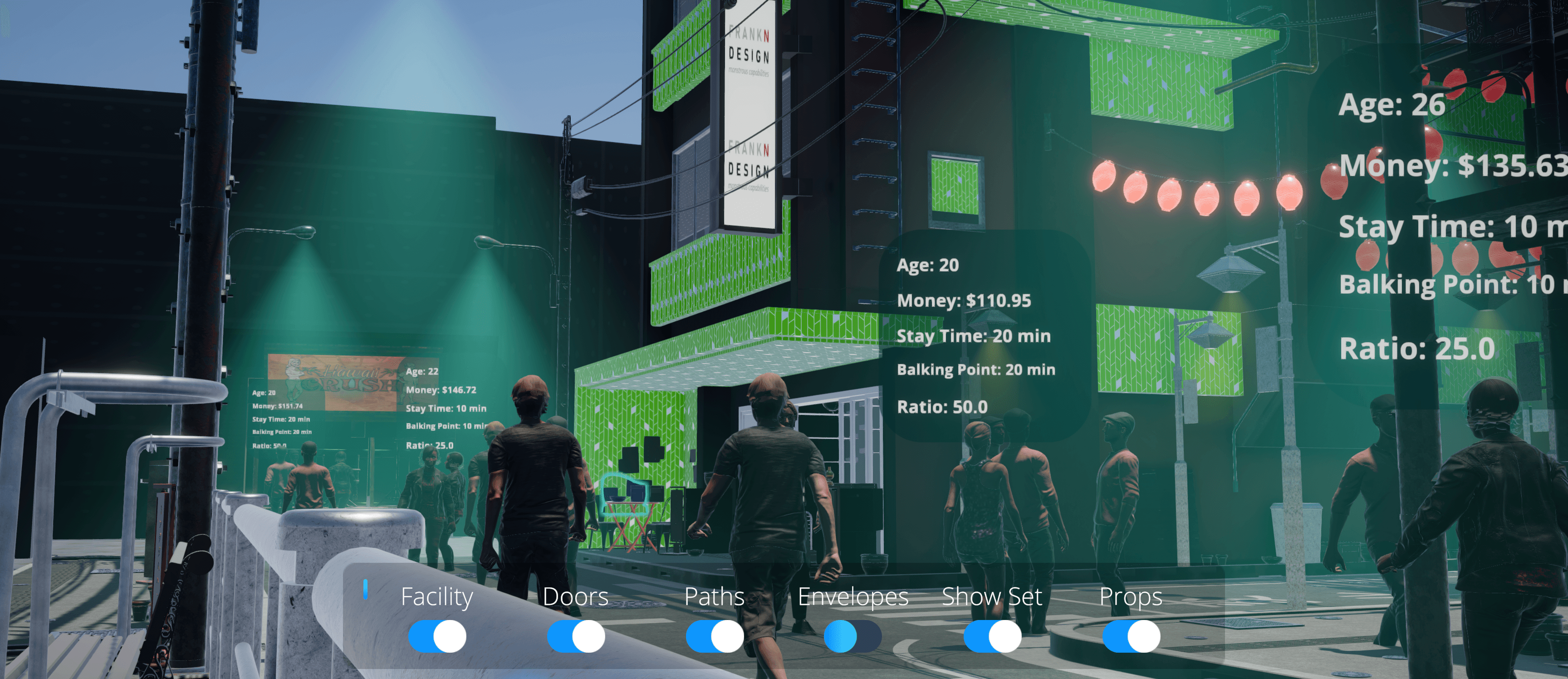
Worldbuildr, a digital twin provider for the location-based entertainment industry, needed a solution to improve stakeholder collaboration. With Unity Asset Manager, they were able to build a digital twin application where architects using tools like Revit could upload their static models. The system would automatically optimize and prepare for real-time visualization in minutes. This bridged the gap between technical and non-technical stakeholders, allowing designers to see their creations come to life and financial planners to simulate ROI based on guest flow—all from a single, centralized asset source. Read the full story.
Establishing sources of truth
The next step is to streamline the approval process to create known, reliable data sets. These “sources of truth”, whether a dashboard, shared knowledge base, or management platform, act as the organizational compass for development. The data guides teams on direction, expectations, and priorities while minimizing biases and confusion. To maintain their value, these sources must be consistently supported and monitored to ensure the latest information is always available. This commitment fosters trust throughout the organization and ensures both internal and external visions are consistently upheld.
Technology’s role in better collaboration
Modern organizations have access to an unprecedented array of tools, each designed to address specific aspects of digital workflow management. However, the abundance of options can be overwhelming. Success lies not in adopting every available solution, but in understanding how different solutions complement each other and benefit both users and the organization.
Three common product categories are often used for effective digital collaboration and communication: Digital Asset Management (DAM), Product Lifecycle Management (PLM), and Content Management Systems (CMS). While these tools have distinct origins and purposes, they can all work well within integrated ecosystems, particularly as organizations embrace real-time 3D and extended reality (XR) technologies.
The key to successful tool selection lies in understanding that emerging technologies can be complementary, working together to solve collaborative challenges. The most effective organizations strategically combine elements from different product categories to create comprehensive workflows that serve their specific industry requirements and team structures.

Preview of a large 3D model in Unity Asset Manager with metadata tagging, version history, and more.
Digital Asset Management (DAM)
A DAM is a centralized system for storing, organizing, and distributing digital assets like images, videos, and complex 3D models. Modern DAMs have undergone exponential increases incapabilities, both in terms of storage and speed. They are the library for an organization's most valuable creative and technical content. Key features required for a DAM to be successful include discoverability, access, and security.
The Unity Asset Manager is a purpose-built DAM designed for the unique challenges of real-time 3D workflows. It addresses the issues identified throughout this guide by providing a cloud-native solution to ingest, manage, transform, and distribute complex 3D assets securely. Acting as the central hub that connects disparate tools and teams makes it an ideal cornerstone for organizations embracing real-time 3D.
Product Lifecycle Management (PLM)
PLM software manages a product's entire lifecycle, from ideation to retirement. Rooted in engineering and manufacturing, PLM systems are focused on governance, traceability, and managing complex development processes.
Content Management Systems (CMS)
A CMS is a platform for creating, managing, and publishing digital content for websites, applications, and other customer-facing experiences. Originally built for web publishing, modern CMS platforms are often "headless" and API-first, allowing them to deliver content to any channel, including immersive XR applications.
Choosing the right tools
These four solutions are not competitors but complementary enablers. They each address different layers of the digital collaboration stack, and are often tailored to the needs of particular roles within a company.
- DAM is asset-focused, prioritizing discoverability and asset usage.
- PLM is product-focused, prioritizing governance and traceability.
- CMS is content-focused, prioritizing publishing and delivery.
In a modern automotive workflow, for instance, a PLM system governs the core engineering CAD data. A DAM makes approved 3D models accessible to the appropriate cross-functional teams, such as sales, marketing, and procurement. A CMS publishes those assets to a customer-facing car configurator. Choosing the right mix depends on your industry, team structure, and specific needs.
Change management for collaborative transformation
Technology is only part of the solution. To turn collaboration into measurable outcomes, organizations must manage change intentionally by aligning leadership, empowering cross-functional stakeholders, and enabling teams with the practical strategies and training. Done well, this foundation unlocks two advantages: fewer, smarter iterations that reduce cost; and a company culture where trust, clarity, and continuous improvement become standard. The following sections explore how pro-collaboration practices cut unnecessary cycles and how those wins, repeated over time, build a sustainable culture that elevates trust, and improves workflows and efficiency.
Less Iteration, Less Cost
Embracing pro-collaboration strategies enhances communication, which in turn clarifies objectives and minimizes iterations. While cycles and ideation are essential steps in any production process, iterations that lack constructive insights or positive outcomes deplete resources and finances. By providing effective direction and feedback for each iteration, teams can build upon their work, maintain efficiency, and lower operating costs.
Collaboration minimizes wasted and redundant efforts by countering biases, creating sources of truth, democratizing data, and improving feedback. Users continue their daily routines, but with enhanced clarity. The result is a quantifiable reduction in user hours per delivery. These savings accumulate over time as resources become available to focus on innovation or quality. A continuous feedback loop is created that positively impacts the entire process, further increasing organizational adaptability and reducing waste.
Collaboration is a competitive advantage to be invested in. As digital tools become increasingly specialized, organizations should focus on shared initiatives that affect every user. This approach creates efficiencies that benefit everyone, leading to overall cost reductions through a unified strategy, rather than directed fragmented cuts.
Building a sustainable culture
The final benefit of a fully collaborative environment is a boost to morale and trust throughout the organization. When individuals spend less time navigating uncertainty and more time on effective execution, their personal outlook is positively impacted by improvements with every success. This leads to trust in the process, as they gain a clear understanding of their position within their team and the company.
This culture of collaboration is a winning attitude where ideas flow, empowering individuals and enriching the entire organization. It’s an ongoing dialogue where all aspects of work benefit without opposing the modern gains of specialized software. Collaboration is an additive process that helps people do what they do better, increasing the value of the organization by increasing the value of its people, one conversation at a time.
Get the e-book
Fill out this form to access cutting-edge insights and solutions from industry experts