What is Unity's 3D Data Engine? FAQs on scaling 3D programs

Enterprises have spent years and budgets making their teams "3D-ready." Yet most of that 3D content stays locked in the files and tools it was created in, unable to reach the rest of the business. Unity’s 3D Data Engine addresses that scenario, with solutions for the end-to-end 3D workflow. Below, we break down what it means, why it matters, and how it works.
What is Unity’s 3D Data Engine?
The 3D Data Engine is Unity's set of solutions for treating 3D content as enterprise data, rather than a one-off deliverable. It focuses on the layer underneath 3D creation: optimizing, organizing, connecting, and continuously updating the 3D assets and workflows that every real-time 3D (RT3D) program depends on. Learn more in our free e-book Beyond the editor: How Unity’s 3D Data Engine powers enterprise 3D data infrastructure.
What problem does this solve?
Across industries, heavy 3D content gets stuck for three recurring reasons:
- Tooling. Source files (CAD, BIM, point clouds, and more) aren't built for real-time 3D applications, and teams already juggle formats that don't talk to each other or to live 3D tools.
- Time. Technical teams spend time organizing, converting, and optimizing files by hand. Non-technical teams spend time requesting files and waiting on feedback. Manual handoffs sit between nearly every step.
- Expertise. Getting 3D into a usable state has required specialist skills that most of the organization doesn't have, so requests pile up on a small team and growth stalls.
What's the fix?
Instead of treating 3D as a one-time output, the 3D Data Engine reframes it as living enterprise data: stored, optimized, organized, connected, and kept up to date automatically. Scaling 3D programs isn't about a better individual app, it's about building a reliable supply chain of well-managed 3D data that feeds everything downstream.
What does the 3D Data Engine look like in practice?
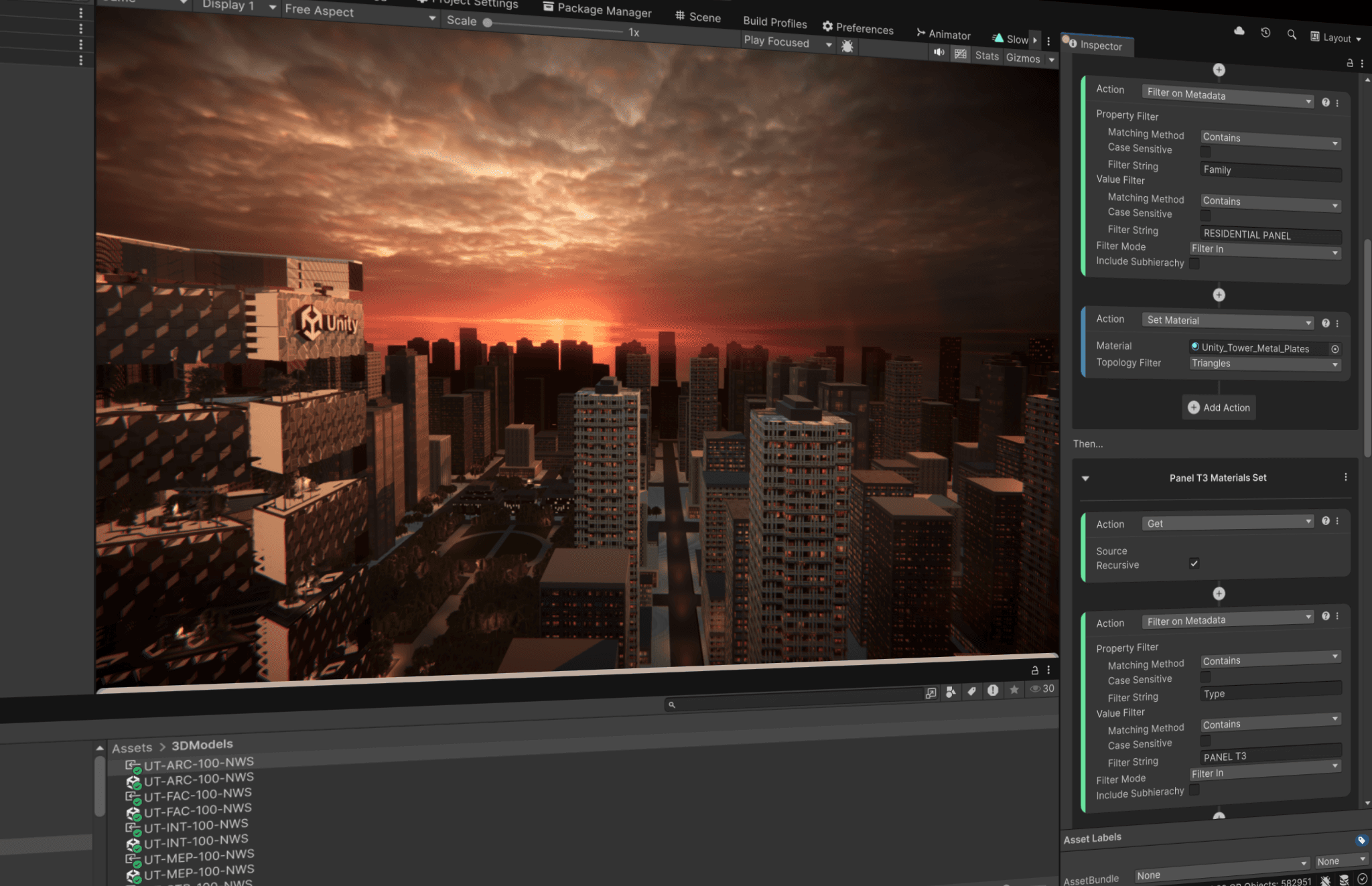
The clearest example is the path from heavy source data to a live application, also known as the CAD-to-RT3D pipeline. A team takes a large, complex source file (a CAD model or BIM file), automatically converts and optimizes it, stores and organizes it so others can find and reuse it, and keeps it synced as the source data changes - all without manual rework at each step.
What Unity capabilities are part of the 3D Data Engine?
Unity's data-solutions products include:
- Unity Asset Transformer: converts and optimizes CAD, BIM, and other heavy 3D/mesh formats into real-time-ready assets.
- Unity Asset Manager: a 3D-aware asset management system for storing, organizing, previewing, and sharing assets so teams can find and reuse what they need.
- Pipeline Automation: automates the workflow connecting the steps above, and integrates with source systems (PLM, BIM, DCC tools) so updates flow through automatically.
Unity's AI capabilities and third-party integrations are also part of this story, since clean, governed 3D data is a prerequisite for reliable AI applications.
Do I need to use the Unity Editor to benefit from this?
No. These solutions are designed to work regardless of whether a team builds with Unity's Editor. Because the asset workflow - ingesting, optimizing, organizing, and connecting 3D data - stands on its own, it can integrate with other 3D and workflow tools. This matters for teams that work in 3D every day but don't currently use Unity to build applications.
How does the 3D Data Engine connect to AI?
AI applications are only as trustworthy as the data behind them. A stable, well-governed 3D data foundation is what makes 3D content usable by both people and AI systems, which is why the 3D Data Engine treats good data management as groundwork for reliable AI use cases, not a separate initiative.
Who is the 3D Data Engine for?
It's most relevant to teams working with large volumes of 3D content across industries like automotive, manufacturing, transportation, retail, healthcare, and architecture/engineering/construction (AECO). It applies most directly to:
- Technical practitioners: 3D engineers, designers, and developers who feel the daily friction of manual file prep and handoffs firsthand.
- Technical leaders: those responsible for scaling 3D programs or data infrastructure, who care about governance, cost, and long-term scalability.
Organizations with more complex data ecosystems (many assets, multiple teams, layered workflows) tend to see the most value.
What's next?
If the pain points above sound familiar - files that take too long to prep, assets that are hard to find or trust, or a small team that's become a bottleneck for the rest of the business - that's the problem the 3D Data Engine can solve. Check out our Industry Solutions, or contact us to learn more.