How Navegante reached more players with less resources
Aiming global with a small team
How does a small, extended family of Latin American (LATAM) developers and artists release an exciting 2D platformer for all major consoles and PCs – simultaneously and on time? With a team of collaborators spread across Mexico and South America, Navegante Entertainment wanted to do something amazing with very limited resources.
The challenge
Coordinating certifications and simultaneously launching the studio’s first game for all next-generation console and PC platforms
Platforms
Nintendo SwitchTM, PC, PlayStation5, Xbox Series X|S
Team members
8
Location
Mexico and South America

Putting multiplatform reach first
Long before they finally decided to open a studio in 2019, close friends Rodrigo Fernandez and Gustavo Alcala learned Unity in their spare time for over six years. “As we learned more about the engine, Unity began adding lots of functionality for 2D,’’ Rodrigo explains, and they honed their 2D skills as the Unity tools matured.
But when Navegante was getting ready to launch their 2D platformer, the most important Unity capability was being able to to quickly turn out certifiable multiplatform versions. Working with Unity enabled the Navegante team to simultaneously launch downloadable and physical game packages for all their target platforms.

The results
- Launched download and physical versions simultaneously for all platforms
- Built a fully playable Nintendo Switch version in less than a week
- Achieved 60 fps performance on all platforms
- Saved 50% time on asset creation for marketing using the Unity Recorder
- Awarded Grand Winner, 2022 NYX Game Awards; Winner, 2022 Ibero-American Animation Quirino Award; Winner, 2021 Latinx Game Awards
Nintendo Switch is a registered trademark of Nintendo.

Building a family tradition
Navegante’s LATAM roots support a strong family- and friend-oriented work culture. Rodrigo’s sister Anahit Fernandez is the director of production, and they play online games together with their collaborators in Mexico, Argentina, and Ecuador – after daily scrums, of course.
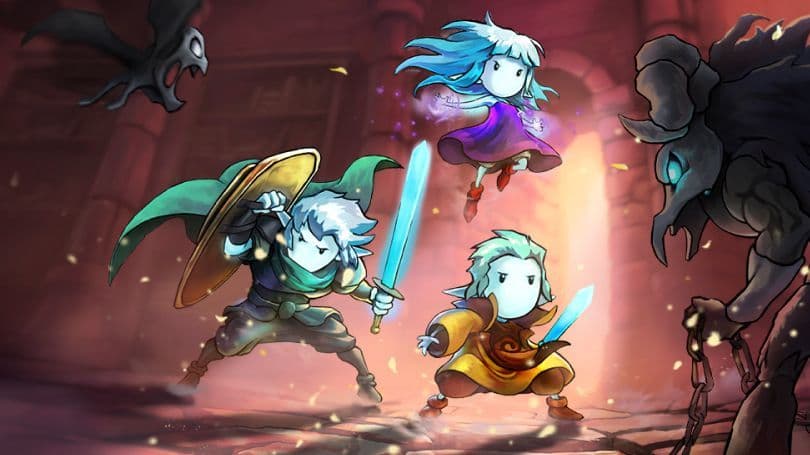
These family roots extend to Greak: Memories of Azur, where three characters, Greak, Adara, and Raydel, are siblings who scramble to fight off invaders and collect parts for an airship that will take them to a more peaceful land. A player switches control from one sibling to another to access character-specific capabilities in different gameplay scenarios. According to Anahit, “Controlling multiple characters is really the core identity of our gameplay.”

Sparking a richer game
Greak is a side-scrolling single-player game with hand-drawn animations enhanced by custom lighting and a bespoke parallax system. Navegante complemented traditional art and animation with a lush soundtrack featuring a live orchestra of 82 musicians from the Tecnológico de Monterrey.
Early creative work on the game featured a simpler art style, while fighting consisted of throwing various projectiles at enemies. Anahit says, “Everything changed when Nicolás Martinez joined the team as art director. He brought a much more serious art style and a new level of combat options.”
The team faced many challenges since they then needed to draw entire levels as large illustrations to integrate them into Unity, making level changes difficult. Fortunately, Unity 2D tools solved this production bottleneck. “We started using all the new 2D tools in Unity, and it solved a lot of our production problems. They saved us time and allowed us to create much more complex stories around the characters,” Rodrigo explains.

Keeping production schedules
Executing a simultaneous multiplatform launch was the Navegante team’s biggest challenge, not least because they had committed to having packaged console games ready for brick-and-mortar retail outlets. Launching on Nintendo Switch, Xbox Series X, and PlayStation 5 also meant they had to coordinate their development with platform certifications. There was no room for error, so Navegante tightened up their production schedules considerably.
“Unity is known for its multiplatform capabilities, and we made full use of them,” says Gustavo. He credits Unity’s dedicated forums and documentation for the different platforms, saying these for helping them to solve unforeseen issues. A video playback bug was especially troublesome until a developer pointed them to a particular Unity point release.

Starting with a flick of the switch
They chose to develop for Nintendo Switch first to minimize optimization problems and maintain a stable 60 fps rate as they branched to PC, PlayStation, and Xbox versions.
“We targeted Switch as our base platform because games like Greak are just a lot of fun to play on a portable console,” says Gustavo. Originally, they thought they would need external help to bring the game to Nintendo Switch, but when they decided to try it themselves in Unity, they were surprised to have a playable version in less than a week. “Deploying and profiling builds on the Nintendo Switch was extremely practical,’’ says Rodrigo.

Tackling multiplatform issues
They experienced a similar ease when it came to developing for PC. Rodrigo confirms, “Integrating the Steam ecosystem into the project was very smooth and allowed us to take advantage of its additional features.’’
Bringing the game to PlayStation, with its new haptic feature, was also seamless in Unity, letting Navegante spend time optimizing its use in gameplay rather than figuring out how to make it work. And they could integrate Game Core runtime functionality to easily test and develop on both Xbox One and Xbox Series versions using virtually identical source code.

Making the most of 2D tools
“Unity’s suite of 2D capabilities was essential to our development, and it seemed like each new feature stimulated something new in our gameplay,” says Rodrigo. After what he called an “extremely easy upgrade midway through development,” the team was able to take advantage of expanded sprite editing using Unity Physics 2D and Polygon Collider 2D capabilities. These eliminated the need to repaint scenes in Maya, which turned out to be a huge timesaver. They also made extensive use of Unity’s Animation View, Animator, and the Sprite Editor.
To quickly create landscapes and levels with a handcrafted look, the studio went to the Unity Asset Store’s Ferr2D Terrain Tool. “Ferr2D was very important for development because before we had hand-painted backgrounds. Using the plug-in gave us a big boost and made the game what it is today,” says Rodrigo. He added that although they could have coded their own tool, using an existing Asset Store tool was much faster and added flexibility.

Optimizing for performance
As the team moved closer to building release candidates, the Unity Profiler and Unity Frame Debugger played a big part in optimizing performance, as well as enabling 60 fps with dynamic resolution. And to create marketing content for the launch, Navegante relied on the Unity Recorder.
“The Unity Recorder was a hidden gem, it’s very versatile and captured video and audio clips in any size or format we needed and cut over 50% of the time invested on marketing asset creation,” according to Anahit. It also helped the Navegante team record on many different resolutions, including ultra-wide monitor support, and it provided them with multiple graphic options for PCs.

Teaming up for shared success
Navegante’s next project is under wraps, but Gustavo says they are busy prototyping ideas. The team started with an upgraded Unity version that offers even more 2D capabilities that leverage the Universal Rendering Pipeline (URP). He also mentioned having instituted more disciplined version control for future production. “Especially with a remote workforce, version control makes a night-and-day difference,” he says.
As a studio with a strong sense of family, partnering and working with others comes naturally. They strongly recommend that developers take part in Unity forums and other media such as the Unity Creator Spotlight series. According to Rodrigo, Unity and its community let the team spend its time on optimizing gameplay instead of figuring out technical issues, particularly when bringing the game to other platforms.
“The game would not have been what it is without Unity,” he concludes. “It would be impossible for us to do a multi-console release for a team of our size with our own engine. Unity has been an invaluable partner throughout.”

““Unity’s suite of 2D capabilities was essential to our development, and it seemed like each new feature stimulated something new in our gameplay.””

Rodrigo Fernandez - Navegante
Co-Creative Director & Lead ProgrammerAccess a wider audience and feel confident that your IP will be ready for the future. Create your content once and launch it across more than 20 platforms to captivate players across formats.