How to reimagine a classic sports game for a new generation with level design, worldbuilding, and VFX

Terra Marie Kincy - Mega Cat Studios
Implementation Visual Lead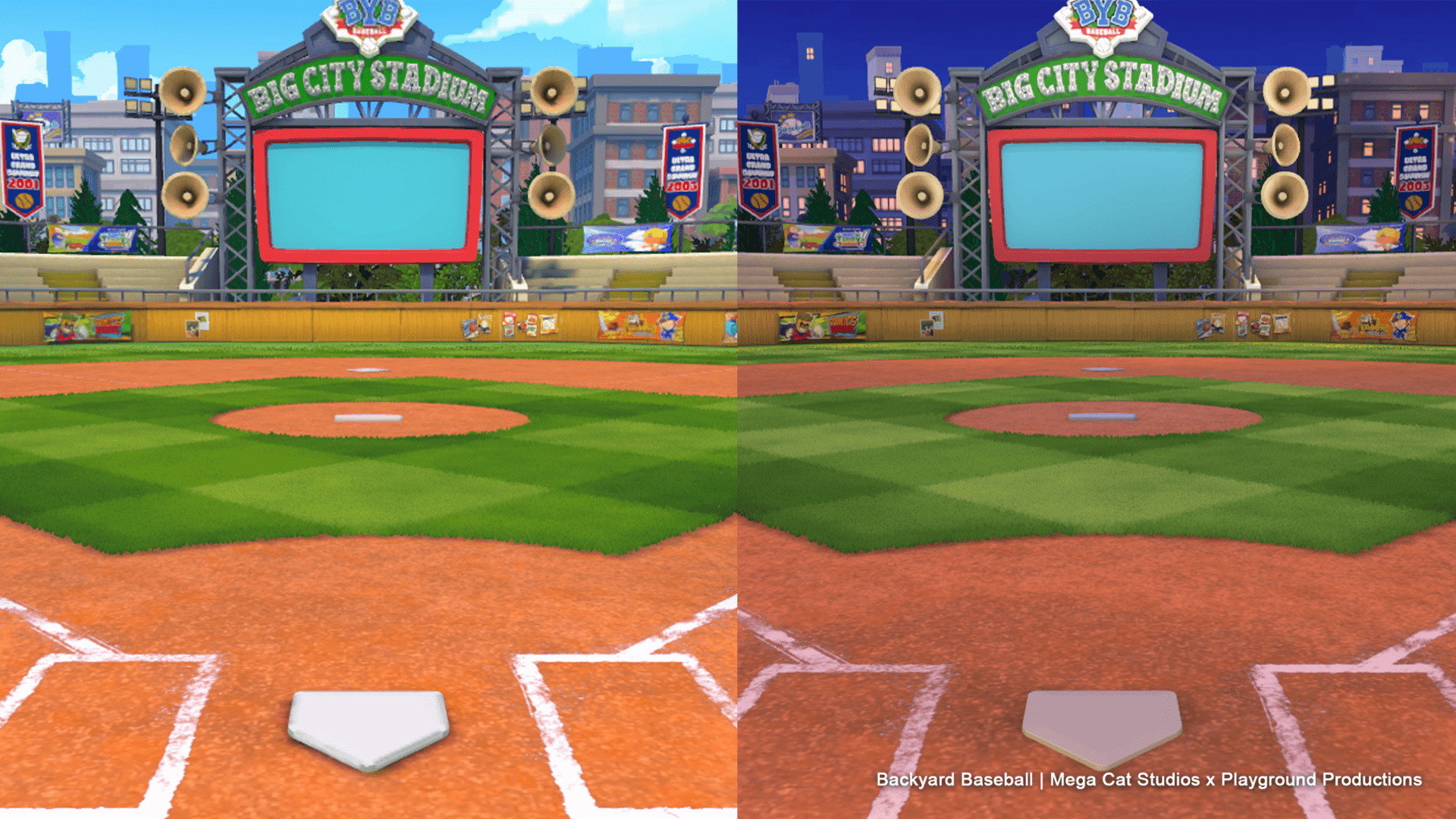
This is the third in a series of blog posts by Mega Cat Studios where they share their Unity expertise and solutions for real-world commercial game development challenges. In this post, Terra Marie Kincy, Implementation Visual Lead at Mega Cat Studios, explains how they balanced technical depth and authentic nostalgic charm in their quest to revamp and release an all-new 3D version of the legendary game Backyard Baseball.
Read the other posts in the Backyard Baseball technical tips series:
1. Scaling Unity workflows: Lessons from medium to large projects
2. Batting a thousand: How Unity’s event-driven Input System powers controls in Backyard Baseball
3. Rendering at scale: Efficient strategies for massive object counts
Since the late 1990s, the Backyard Sports franchise has carved a distinct space in the sports games genre by presenting athletics through the lens of neighborhood play. The franchise covered baseball, hockey, football, soccer, and basketball.
Alongside the unforgettable characters and accessible gameplay, the environments also play a crucial role in the fandom’s connection to the series. Rather than just serving as functional spaces for playability, each field acts as a subtle form of storytelling. The designated home fields offer a glimpse into the characters’ everyday lives, while the city stadiums provide context to the Backyard universe being a lived-in community. We want the Backyard world to evoke a powerful sense of nostalgia and familiarity, while capturing the magic of competition rooted in having fun.
Debuting as the first release of the Backyard Sports lineup in 1997, Backyard Baseball featured distinct 2D environments designed for quick, repeatable gameplay. For our release of Backyard Baseball, our team needed to reimagine these environments in 3D. Our goal was to maintain each field’s classic layout while updating its visual and interactive depth. The objective was not to alter the fields' structure, but to lean into environmental storytelling and make the game feel more immersive for players.
Design for readability
We treated readability as a foundational design requirement rather than a final polishing step. Each environment is thoughtfully crafted to be intuitive and recognizable. As a game designed for quick pick-up-and-play action, it was crucial in the process to make sure the world felt complete and understandable at first glance.
To achieve this, our team established a clear and consistent approach to level design. Every element was strategically positioned to define boundaries and interactive zones, while decorative details were placed to add charm without introducing visual distractions.

Early concept art for the Super Colossal Dome, next to how it looks in the 3D level
Foreground, midground, and background elements are separated using color, contrast, and/or lighting. This organization keeps essential gameplay information legible while allowing the surrounding environments to be more visually expressive and detailed.
Props and world-building
Each field is built as a fully realized 360° environment to support replays, alternate camera views, and to deepen the lore of the Backyard universe. Props and set dressing establish each location's distinct identity. Our team put extra care into crafting a world that feels complete from every angle while remaining visually organized during active play sessions.

A screenshot of the Cement Gardens Camera before and after set dressing

More screenshots of the Cement Gardens from all directions
To ensure a smooth experience across all devices, optimization is central to our product design. Vertex counts were managed based on an object’s size and distance from the camera to maintain high performance. Material usage was equally controlled by favoring shared materials and adjusting texture sizes to reduce the hardware's workload.

Example of a high vert model next to a low vert model

Base Texture Settings vs Specular Texture Settings
Decals for environmental detail
Environmental detail is used to reinforce physical space rather than simply as decoration. Our level design team used the Decal Renderer Feature in Unity to convey real-world elements such as surface wear, dirt, cracks, and footprints. This allows environments to feel lived-in and reactive while preserving performance and visual cleanliness.

Sandy flats without decals (left) vs them with footprint decals (right)
Applying decals starts with identifying surfaces that need more visual variation without affecting gameplay or collision. Integration is further supported through carefully adjusting texture settings, opacity, and mipmaps. This prevents visual "glitches" and keeps the environments consistent across the Backyard universe.

Footprint decal with Inspector settings

The Material settings for the Footprint decal
Key considerations during setup include:
- Consistency: Ensuring decals respect the scene's lighting and shadows
- Accuracy: Using render layers to prevent distortion
- Blending: Adjusting opacity so decals blend naturally
- Subtlety: Limiting normal intensity so surface details have the correct depth
Through this controlled process, decals add a layer of visual enhancement without altering the clarity or function of the field.
Interactive VFX
To bring the neighborhoods to life, we integrated reactive VFX and scripted animations that respond to on-field action. Since the ball is the primary driver of interaction, our team developed a system that triggers unique physical responses when the ball connects with the environment. For example, if a player hits the ball into a light fixture, the light may flicker, while if the player hits the ball into a bush, a squirrel may run out. These scripted events help the world feel more fun and immersive.

Water visual effects from Backyard Baseball
These subtle visual cues confirm the player's power and accuracy, adding a layer of satisfaction to the gameplay while keeping the focus on the sport.
Blending materials
Material blending plays a key role in ensuring environments feel cohesive and lived-in. We adjusted material settings like blending modes, smoothness, color variation, and normal intensity to avoid transitions that can look artificial.

Example of a Field Line Material settings in the Wiffle Ball cul-de-sac

How the same Field Line Material effect in the Wiffle Ball cul-de-sac looks in the game
Lighting
To maintain focus, primary play areas are kept consistently sharp and visible, while atmospheric fog and material adjustments are used to create perceived distance with the surrounding elements. Lighting further reinforces these boundaries, solidifying the separation of foreground and background elements for the player.

An atmospheric effect on trees behind the baseball diamond
Whether playing in day or night mode, materials are adjusted to respond realistically to the environment's lighting conditions. This consistency helps maintain a more unified appearance across the Backyard universe.


Examples of day lighting vs night lighting from the neighborhood and the baseball diamond
By prioritizing instant readability and visual restraint, each field supports frequent play without feeling static. The result is a collection of expressive, responsive baseball fields. In this era of Backyard Baseball, environmental details are enhanced to elevate the playing experience without competing with the game's core mechanics.
These design decisions reflect Mega Cat Studios’ commitment to crafting engaging, high-quality experiences that everyone can enjoy. We are honored to deliver the spirit of the franchise by balancing modern technical depth with the charm of the original games. We can’t wait for players to return to the neighborhoods they love.
Grab your gear and batter up!