Building a data-driven board to power Sente’s six-player strategy

Fergus Baird - Unity Technologies
Senior Content Marketing Manager
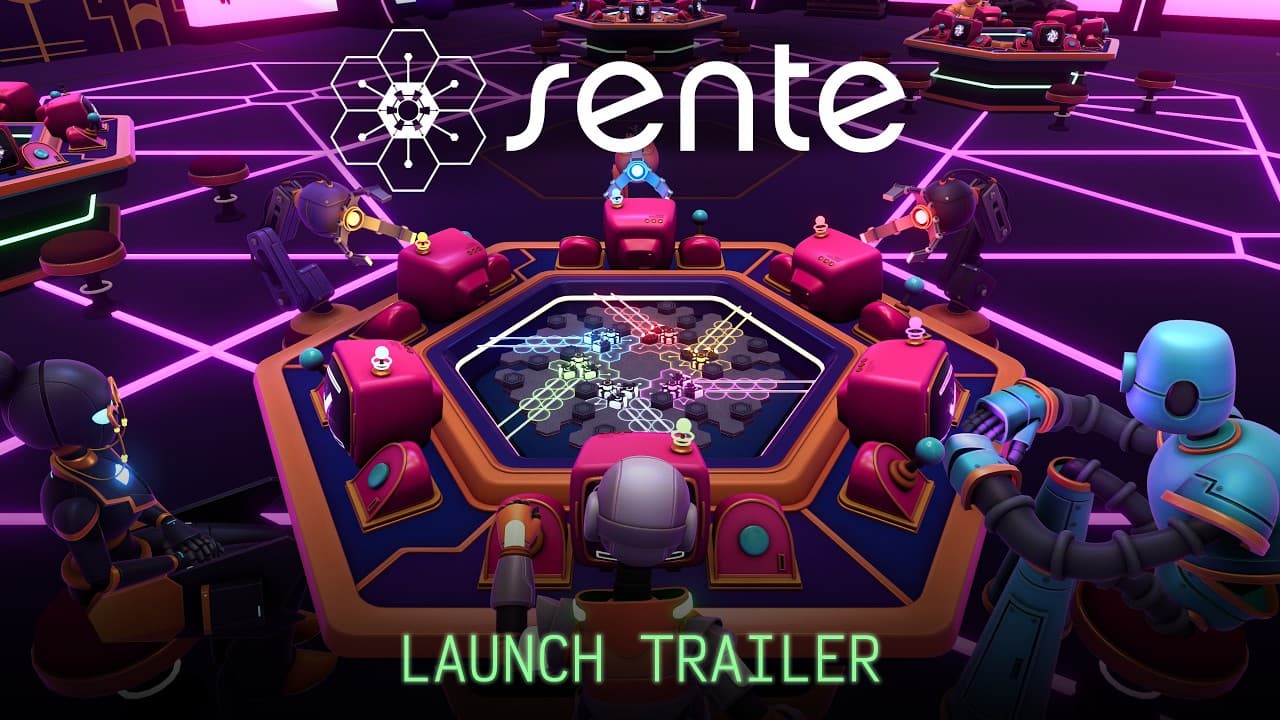
What happens when you take the strategic depth of chess and Go and let up to six players move at exactly the same time? That’s the premise behind Sente, a hex-board strategy game from Argentina’s Oxobox Games that’s made with Unity. Players drop tokens onto a hexagonal board to build energy networks, fire lasers, and hunt down opponents’ energy cores – all while everyone else at the table is plotting the same thing, simultaneously.
We spoke with Fernando Picate, game director and lead programmer (and one of the studio’s co-founders), and Joaquín Frere, producer and PR lead, about resolving six players’ moves at once, building a board editor simple enough that their own game designer never had to open Unity, and turning a decades-old passion project into a published game.
From a tabletop hobby to a decade-plus in Unity
Sente is Oxobox’s first game; the studio also works in film and TV post-production, providing subtitling, dubbing, and quality control for the entertainment industry. However, Sente actually predates the studio completely. The original idea grew from sketches and paper prototypes the team – who are friends outside work – started tinkering with in the 1990s, based on an idea from game designer Javier Mrad. The first playable attempts were built in Flash as a two-player game, with a brief detour into HTML5 canvas before they landed on Unity.
“I kind of felt at home with Unity right away, though I’m not sure why – I don’t even remember what it was about Flash that felt similar,” Fernando says. “At the time, Unity also supported JavaScript, which felt a lot friendlier than jumping straight into C++ for something like Unreal Engine. Once JavaScript and Boo were deprecated, we moved over to C# for good – and I still love working in Unity today.”
That jump to Unity (starting out in 4.0 LTS, as Fernando recalls) is also when Sente moved from a 2D prototype to the fully 3D board players see today. The team has kept upgrading ever since, and now develops Sente in Unity 6.

Sente | Oxobox Games | Curveball Games
Designing a board game where nobody needs to wait their turn
Sente’s board is built around energy cores – internally, the code still calls them “kings” – central pieces that radiate energy to the cells around them. On their turn, players can move their core or drop a token onto an energized cell. Tokens have two sides: a metal side that shields against lasers and conducts energy to neighboring tokens, and a vulnerable side that fires a laser once charged. Chain enough tokens together and you can snipe an opponent’s core from across the board; lose track of your own network, and the same thing happens to you. Destroy the right tokens and you can even merge two connected pieces into a brand-new energy core – suddenly playing with two “kings” instead of one, much like having two queens on a chessboard.
The catch: with up to six players, resolving moves one at a time made matches unbearably slow. So Oxobox rebuilt Sente around simultaneous turns.

Sente | Oxobox Games | Curveball Games
“When a turn starts, there’s a timer, and every player chooses their move,” Fernando explains. “Once everyone’s decided – or the timer runs out – the turn resolves all at once.” That means a player can line up what looks like a guaranteed shot on an opponent’s core, only to watch it miss because that opponent moved a shield into place in the very same instant.
Keeping six-player matches from grinding to a halt took years of tuning. “A lot of our testing went into making sure boards don’t get stuck,” says Joaquín. “When everyone’s built up their defenses, it can feel like nothing’s happening, but there’s always an incentive to make a move. Eventually someone creates enough possibilities that the others can’t track them all, and that’s when a match breaks open. Between strong players, those matches can stretch past an hour – otherwise, you’re looking at ten or fifteen minutes.”

Sente | Oxobox Games | Curveball Games
One data model, dozens of tools
Every board in Sente – whatever its size, whatever pieces sit on it – is stored as the same underlying logical model, completely decoupled from how it’s rendered on screen.
“Every board is stored as a logical model, separate from what you actually see,” Fernando says. “That same data drives everything: our in-editor board tool, in-game board randomization, and the templates we ship with the game. We can reshape a board any number of times per second without ever touching a scene object directly.”
That single source of truth is what lets Oxobox offer hexagonal boards from size 4 up to size 10 (“size” being the number of cells lining each edge of the board) – small enough to keep quick matches snappy, large enough to support the studio’s more elaborate single-player puzzles, all without maintaining separate systems for each. It also underpins Oxobox’s custom Board Template Manager, an editor tool built directly into Unity that lets Fernando paint boards by hand – cores, tokens, obstacles, and holes – with paintbrush and symmetry tools, then save the result as a reusable template.

Oxobox's custom Board Template Manager is an easier way for the team to build boards inside Sente.
The board editor that didn’t need Unity at all
This same data model solved a much more specific problem: how do you let a non-programmer design puzzles for your single-player campaign?
Sente’s puzzle designer, Javier Mrad – the same person whose original idea started the whole project – has never installed Unity. “Not once, no matter how many times I asked,” Fernando laughs. “That’s actually what forced me to build a proper in-game board editor. Every board can be exported as an encoded string, so Javier can design an entire board or puzzle layout on his own spreadsheet, send me the string, and I import it straight into the game.”
Oxobox plans to expose that same sharing mechanic to players, so they’ll eventually be able to create, export, and trade their own boards, too.

"The best way to work with a creative person like our Game Designer, Javier Mrad, was to follow his rules. A string was all we needed." – Joaquin Frere, Producer and PR Lead, Oxobox Games
Scripting a single-player campaign with Timeline
Sente’s single-player campaign – where players disguise themselves as a robot to sneak into a bar and challenge its regulars – is built almost entirely on Unity’s Timeline package. Each level, or “branch,” is a Timeline sequence that weaves together dialogue, camera movement, and board changes.
To make that work, Oxobox built several custom Timeline tracks: one to move dialogue characters and set their expressions, one to move the camera along custom splines for cinematic sequences, and one that transforms a board from one state to another mid-timeline, animating the change instead of cutting to it. Branching is handled with Timeline signals and markers, which let the campaign jump forward on a win or loop back to a retry point when a player makes a mistake.

"There's a story to tell besides the Sente board, and we wanted to make it look good, and feel cinematic." – Joaquin Frere, Producer and PR Lead, Oxobox Games
“We use Timeline constantly, and I’ve never run into a real issue with it,” Fernando says. “The tutorial is probably our heaviest sequence – it’s got dialogue, board changes, and camera movement all layered together – but even our tournament finale, which uses custom spline tracks for the camera and characters, runs on the same system.”
Those same dialogue tracks double as Oxobox’s localization pipeline. “We already had a lot of localization experience from our background in subtitling and dubbing,” Fernando says. “We built our own localization manager directly into our dialogue clips, so we can edit translations for a line the moment we’re writing it. Right now we’re localizing into Japanese, Chinese, Korean, and a few more languages, all through TextMesh Pro.”

"Localization done right, and organized!" – Joaquin Frere, Producer and PR Lead, Oxobox Games
What’s next for Oxobox Games
Oxobox has partnered with publisher Curveball Games, and Sente is currently available on PC via Steam with the team aiming for Steam Deck verification and exploring console platforms down the line.
For a project that’s been in the making since the 1990s, Sente is a reminder that a small, resourceful team can lean on Unity’s Editor tooling to build something far bigger than its headcount – from a board that reshapes itself dozens of times a second, to a puzzle designer who’s never opened the Unity Editor at all.
Sente is available on Steam, and check out more stories from Unity developers on the Unity Blog and Resource Hub.