How Triangle Factory gained a cross-platform tactical advantage

Breachers: A Unity case study
How can a lean studio deliver cross-play connectivity on all major VR platforms? Following the success of Hyper Dash, Triangle Factory knew that success meant maximizing player and platform reach while keeping their small team focused on gameplay. They used UGS’s backend and community solutions to kick down the door to an untapped market.
The challenge
Powering cross-platform play across VR devices with a lean team
Platforms
Meta Quest, PlayStation VR2, Pico, Windows, Steam
Team members
30
Location
Ghent, Belgium
Closing in on a new VR format
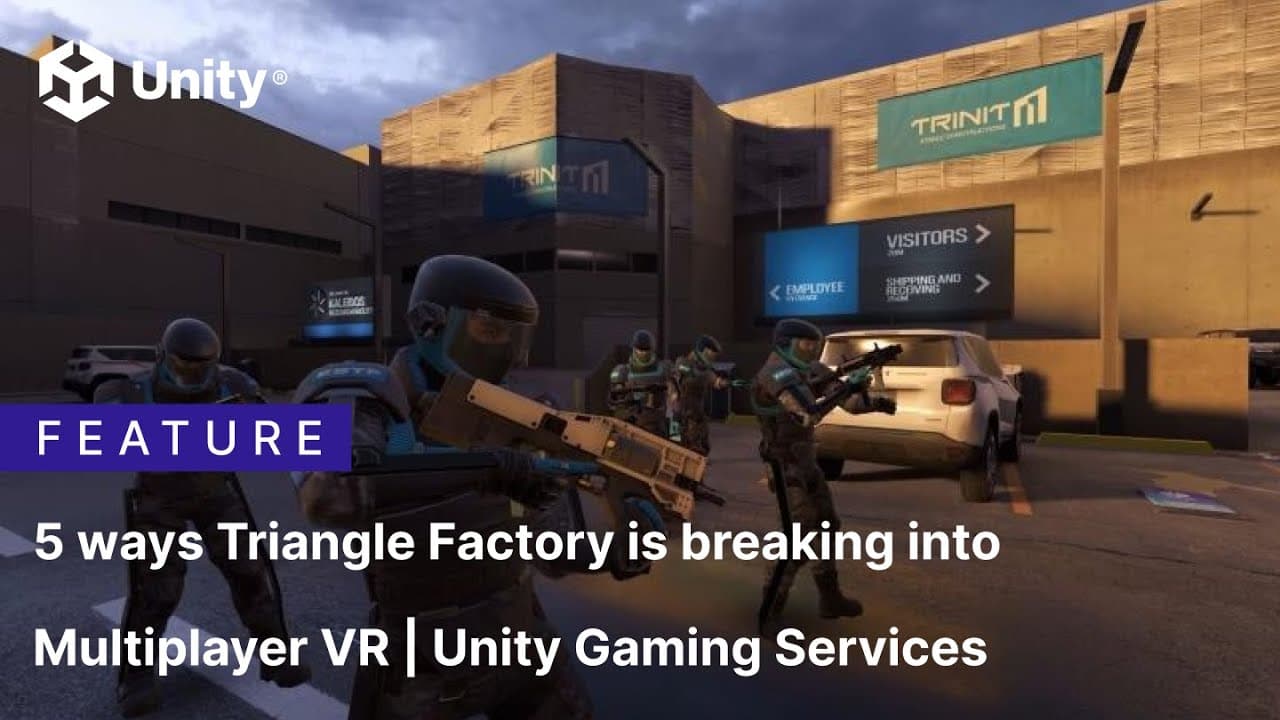
Breachers is the first 5v5 tactical FPS for VR, and platform reach was critical to ensure a critical mass of players. With UGS’s cross-platform capabilities and Unity’s multiplatform support, Triangle Factory was able to deliver a flawless launch on all major VR platforms.
The results
- Smooth launch with 110k MAU in the first month supported by UGS backend architecture and Multiplay Hosting
- Saved eight weeks of development time with Authentication, Matchmaker, Vivox Voice Chat, Friends, and Leaderboards
- Reduced server costs by up to 25% with a hybrid Multiplay Hosting server orchestration

Tapping the full potential of the VR market
Timothy Vanherbergen, Triangle Factory’s CEO, emphasizes that, “cross-platform play was the number-one priority so we could ensure an active user base across different VR systems.”
VR offers exciting gameplay potential, but players are spread across a variety of devices, each with its own unique inputs.
“Vendors often add features that are unique to their devices,” says Triangle Factory’s CTO, Pieter Vantorre. “Unity provides the necessary tools to adapt to these changes. The wrappers for different libraries help us make the most of each device’s unique features.”

Reducing resources and complexity
Triangle Factory uses battle-tested multiplayer tech from UGS to accelerate backend architecture work, helping developers concentrate on new features and optimizations.
“We’re game developers at heart, focused on writing gameplay code,” says Pieter. “Our team has a few technical experts, but even the minimum backend requirements for Breachers became a bottleneck. Had we built everything UGS offers ourselves, it would’ve required more resources and significantly more funds.”
Pieter’s team also appreciates the cost effectiveness of services like Multiplay Hosting. Leading up to launch, they worked with Unity teams to optimize server orchestration so that 90% of Breachers’ server instances are running on bare metal with cloud as a backup. By working with the Multiplay team, Triangle Factory delivered cross-play connectivity at 20–25% of the cost of other providers.

Zeroing in on zero latency
In competitive gaming, the server is the single source of truth – which means the client often has to update its calculations based on the server’s data. Lowering latency is essential since this reduces the need for these updates and improves frame rates.
“Our biggest hurdle was making sure our advanced movement mechanics like leaning, rappelling, and crouching were comfortable without causing motion sickness,” shares Pieter. “To accomplish this stable frame rate is critical – a minimum of 72 fps is needed, but 90 fps is preferred.”
Triangle Factory uses Multiplay Hosting and Matchmaker to group players with low ping together, ensuring a smoother gaming experience. Multiplay Hosting’s global network and automated server management empowers Triangle Factory to deliver gameplay that is responsive and nausea-free.

Saving time with player connection services
Enabling player connections is essential for Triangle Factory’s retention strategy.
Triangle Factory streamlined their backend development by using Friends, Lobby, Leaderboards, and Authentication from Unity’s Backend and Community Solutions suite, all of which are platform-agnostic and cross-platform enabled. Friends lets people build lists of other gamers to play with, while Lobby makes it easy for them to start a game together. These services work seamlessly with Authentication to manage and secure player identities.
Instead of building these features themselves, the team chose to use UGS. “Friends and Lobby reduced development time on player features from a few weeks to a few days. It saved us a lot of time,” says Pieter.
And that strategy has paid off – the game has multiple leagues with over 200 teams. “Our Friends UGS system is crucial for getting those communities together in a game,” says Timothy.

Improving retention with better matchmaking
“In the VR space, where you have a much smaller player base, retention is crucial,” notes Timothy. Triangle Factory uses matchmaking strategically to help keep players active.
The team noticed that retention was higher when new players were matched together. Using Matchmaker’s custom rules, Triangle Factory matches players based on skill level, accumulated experience, and geographic proximity, which helps to reduce latency.
“It’s very easy to set up those rules, and Matchmaker lets us relax them when a suitable skill or experience match can’t be made,” says Pieter.
Triangle Factory continues to test out new rules as they work on a new competitive mode.

Setting up player comms
The focus on fun social experiences carries over to in-game comms, where effective teamwork is key to the action. Triangle Factory uses Vivox Voice Chat to connect players with crisp audio across all major VR platforms.
“Voice chat is super important because teamwork is the biggest factor to win a match,” says Timothy. “A well-communicating team is always going to have the upper hand over a non-communicative team.”
Triangle Factory takes advantage of Vivox’s channels to split chat between teams during matches. In the lobby, pre- or post-match, channels are unified so players can meet and socialize. Vivox Voice Chat in Breachers sharpens team tactics and creates camaraderie, setting the stage for magic multiplayer moments that keep players coming back.
“It just works,” Pieter adds. “Both the service and support from the Vivox team is great.”

Achieving a boring launch day with expert-led hosting
To get Breachers on VR platforms across the globe, Triangle Factory uses a hybrid cloud/bare metal server setup. Pieter appreciates Multiplay’s insights when designing their server coverage: “We get helpful stats from Multiplay about our player capacities. This helps us optimize our coverage and monitor performance.”
Day-one player counts can be difficult to estimate, but collaborating with the Multiplay team ensured they were ready for a sudden influx of players. “We worked with the Multiplay team, going back and forth, making sure cloud scaling was up and running and that our server capacity was nicely tuned,” Pieter says.
With 110k MAU in the first month, Triangle Factory considered the Breachers launch “flawless.” By relying on purpose-built tools to shore up their backend, the team could focus on creating innovative gameplay and trust that everything would just work for players at go-time.

““For a company creating LiveOps games like ours, having a solid backend architecture is crucial. UGS allows us to focus mainly on developing the game, rather than building a scalable backend architecture.””

Timothy Vanherberghen - Triangle Factory
CEO and CofounderUnity Gaming Services help developers configure, manage, and automate services at scale, while staying within the Unity ecosystem. Trusted by some of the world’s top studios, UGS can help you streamline your tech stack so you can focus on your game.